
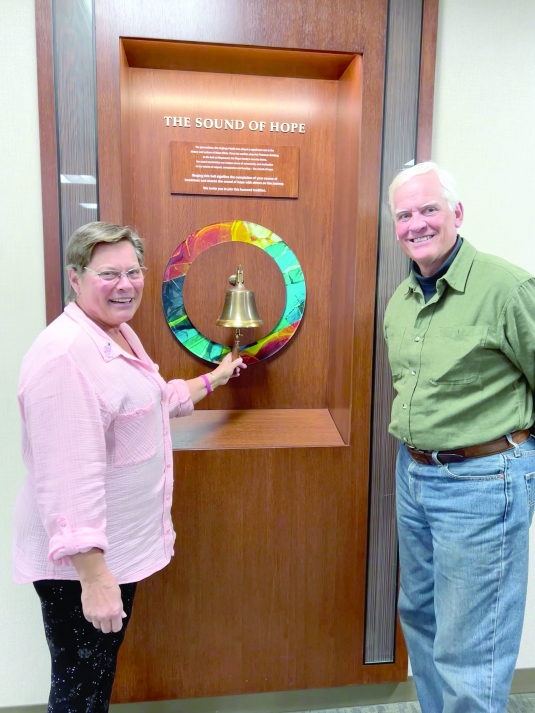
RINGING OF THE BELL - RINGING OF THE BELL - Jeanne Sexton, seen here with her husband Tom while ringing the bell which indicates a round of cancer treatment has been completed, has been diagnosed with and treated for two different types of cancer since 2022.
Jeanne Sexton faces two cancers
Thu, 11/13/2025 - 1:15am
It was definitely a case of one thing after another.
Long-time Waseca resident and Community Education swim coach Jeanne Sexton, 62, was diagnosed with “multiple myeloma," a cancer of the white blood cells, in October of 2022. Since white blood cells are among the chief warriors of the immune system, efforts to combat it can seem rather extreme.
And that’s without a second cancer diagnosis only about 10 months later. The news in 2022 that Jeanne had myeloma was followed in August of 2023 with the revelation she had breast cancer.
Not only that, but across the time she was receiving treatment and then gradually recovering, Jeanne’s husband of 39 years, Tom, was considering his eventually successful run for seat 19B in the state legislature. The two of them are also at a point in their lives when they want to spend time with their two adult sons and their growing families.
Jeanne reveals there are five Waseca area residents who have been diagnosed with multiple myeloma over the past five years or so, most of them having celebrated at least their second or third “birthday,” a reference to the day they completed an important phase of the treatment. She expresses gratitude for the mutual support and understanding their small group can share.
What she and the others learned after being diagnosed is that the affected white blood cells must be eliminated, then replaced with “baby” cells which are not yet damaged by cancer.
Blood cells are manufactured in the bone marrow, the fluid housed in the hollow areas of the body’s larger bones. Treatment for multiple myeloma begins with the harvesting of just-produced white cells–which requires connecting a needle and tubes to the base of the spine.
Jeanne says the process was perhaps not as bad as it sounds, but remembers a startling “snapping” noise that she hopes never to have to hear again. Depending on how things go, the extraction process is likely to take place at least two or three times over a number of days in order to get a sufficient supply.
With the fresh cells removed and safely stored, chemotherapy is targeted to incapacitate the damaged ones still in circulation in the bloodstream. As with many other types of cancer treatment, the chemotherapy is introduced over a number of weeks. Jeanne remembers feeling nauseous and weak during that time, but also remembers with gratitude that this particular set of chemicals did not cause her to lose her hair.
In the case of specifically located cancers, for example in the breasts or in an organ, chemotherapy is often followed by targeted radiation. That is not the case with myeloma, however, because blood circulates to every cell in the body.
Instead, the next step calls for closely monitored care that requires being admitted to a hospital for two to four weeks. The stored white blood cells are reintroduced to the bloodstream and must take up the stalled task of incorporating themselves into the body’s usual operation. It is nowhere near as simple as a typical blood transfusion.
Jeanne describes feeling fatigued, weak, and unable to walk. Even once the critical initial phases are over and patients are released from the hospital stay, they are expected to remain in the vicinity for another ten days or more in case of any emerging problems and for daily treatments and assessments which take at least an hour.
In the parlance of Myeloma, one’s life is considered having started over after the reintroduction of the white blood cells and the associated treatment are completed.
After that, patients are placed in a follow-up regimen of regular testing in the hope of confirming all is well. Tests are scheduled first three months, then six months, and eventually a year apart.
Jeanne was well on her way to her first “birthday” when her routine mammogram revealed she had breast cancer in August of 2023.
After a “lumpectomy” surgery, she again underwent chemotherapy, this time followed by radiation treatments. But she learned she had a choice regarding the radiation doses: “I could either go with 19 less strong treatments or five stronger ones,” she describes. “I chose the five stronger ones.”
Again, she was grateful she was able to retain most of her hair; she did, however, slightly change the way she arranged her hair in order to conceal it was growing thinner in areas. Probably a more important side effect of the treatments and chemotherapy was months and months of having a compromised immune system. In addition to nausea and discomfort from the treatments, Jeanne experienced both pneumonia and salmonella poisoning. She speculates neither would have been as severe nor lasted as long as they did had her immune system been up to speed.
Jeanne finished her treatment and her health was stabilizing just as a critical time in the election process for Tom was approaching. Jeanne and he decided it would be suitable for Tom to go ahead and throw his long-held hat in the ring just shortly before the endorsement process was ready to begin in June of 2024.
She can’t help observing that the month of September is designated for calling attention to blood cancer and the month of October to breast cancer. “They’re right there next to each other, just like my two diagnoses,” she comments.
“It was a lot to go through, but I’ve come through it.
“I would say anyone who has cancer or who has a loved one with cancer has a lot of reasons to be grateful for all the donations and support that people give to research and to helping people as they seek treatment.
“The whole idea of getting a new birthday because of being treated for cancer goes to show how much it changes your life, and your understanding of who you are and what your place in the world is.
“None of us know where life will take us next, including if it might be up to heaven.”