
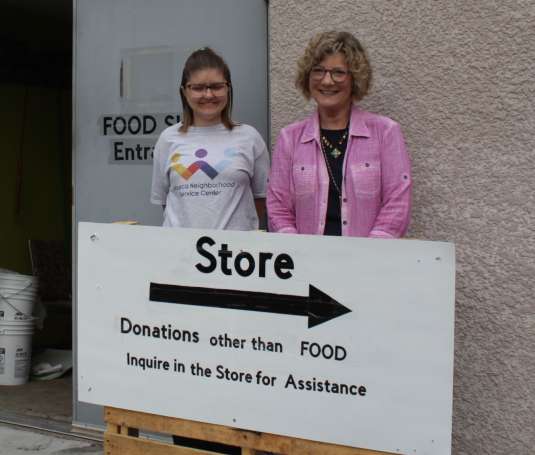
HELPING HANDS - Angela Motz (left) and Cindy Kolander stand near the temporary access to the Waseca Area Food Shelf. The double-wide door is on the south face of the building. The large white sign indicates the path to the front entry of the Neighborhood Service Center's thrift store, a business which helps pay many of the costs incurred by the charitable organization.
Food Shelf supplies far from 'free'
Thu, 10/30/2025 - 2:30am
Even though they hear it fairly often, members of the Waseca Area Food Shelf leadership board are taken aback each time somebody claims the produce, frozen food and shelf stable goods available at the food shelf are “free.”
“Of course we know we don’t charge anyone for it,” clarifies board member and county commissioner Brad Milbrath. “But we also know it takes a lot of money and time to make sure that food is available.”
Cindy Kolander, executive director for the Waseca Area Neighborhood Service Center and the Waseca Area Food Shelf, says she and board members are given cause for deep concern when they see how sharply need is rising. In September, costs exceeded what had been budgeted by more than a third when a total of 585 households–about 1,200 individuals–were served during the month, taking home 17,000 pounds of food.
Operating hours for the food shelf, she mentions are Monday through Friday from 9 a.m to noon and then from 1 to 4 p.m. Workers at the shelf eat a quick lunch at the midday break, then spend their time restocking shelves.
Customers must make an appointment to “shop” for and may do so once a week. With six time slots an hour, representatives from 36 households are picking up supplies each day. The amount of food each shopper is permitted to take depends on the size of his or her household.
Kolander is quick to express her gratitude to all the individuals and organizations that donate to the food shelf. “We’re grateful for everything people give us and for the ongoing good will of the community,” she says energetically.
She goes on to explain that donations of money are more efficient than of purchased food mostly because there are wholesale vendors which work to acquire supplies at bulk rate pricing and then sell them, again at bulk prices. The primary supplier of bulk food supplies to food shelves in Waseca County is Channel One Regional Food Bank, located in Rochester.
Kolander offers the example of frozen beef recently available through Channel One Food Bank at $2.75 a pound. “That’s a great price of course, better than you’ll find in a retail store,” observes Kolander. She goes on to say that, because usage at food shelves all over the country is rising, and because Channel One works to distribute its products fairly across its whole region, the Waseca shelf was given the option of purchasing only 50 pounds when it placed its most recent order.
“Well, 50 pounds is not enough to fill our need to provide a pound of hamburger to 585 households (the count from September),” she points out, “so we had to go out and buy the rest at prices closer to retail.” She mentions that area suppliers are willing to offer the food shelf reduced prices, but only to a point. “That additional meat cost thousands of dollars,” she summarizes.
“For anyone to say it was ‘free’ is obviously far from the truth.”
Kolander goes on to mention that board members, volunteers, supporters and others are persistently hustling to bring in money from various types of sources. She offers the example of a mid-summer invitation from the University of Minnesota Extension Southern Research and Outreach Center (SROC) at the southwest perimeter of Waseca. The SROC had planted a field of green beans to test growing conditions. When the produce was ready for picking, area charitable organizations were invited to help themselves.
“So no, we did not have to pay for the food,” Kolander points out. “But we had to find volunteers or send some of our employees, in some cases transport them to the field, and then transport the produce. Those are costs, too.”
She mentions with gratitude that area retail stores frequently supply food at no cost when it is nearing its expiration date or, in the case of produce, approaching the end of its usable timespan. “Even though they give it to us for free,” she observes, “we still have to find a way to transport it, many times driving to neighboring towns such as Owatonna or Mankato, including loading and unloading it.
“There is essentially nothing on our shelves that came to us at absolutely no cost. And even if there were, there are costs associated with the building itself, including electricity to keep the freezer running and lights turned on.”
Regarding the clothing, household items and furniture donated to the Waseca Area Neighborhood Service Center (WANSC), Kolander acknowledges the thrift store does provide income for the non-profit-although that has been significantly reduced by this summer’s construction.
She explains money from those sales is used to meet ongoing expenses for the site (including the food shelf). Cost of business expenses include paying for business insurance, utilities and trash removal services, meeting payroll, and upkeep on the building, grounds, and equipment. Only after those fundamental costs are met can any money go toward purchasing supplies for the food shelf.
“All this is simply how things are when you run a non-profit food shelf,” Kolander says calmly. “Sometimes it can be rather hectic around here. Neither I nor the board members are complaining. We are so thankful we are able to offer this service.