
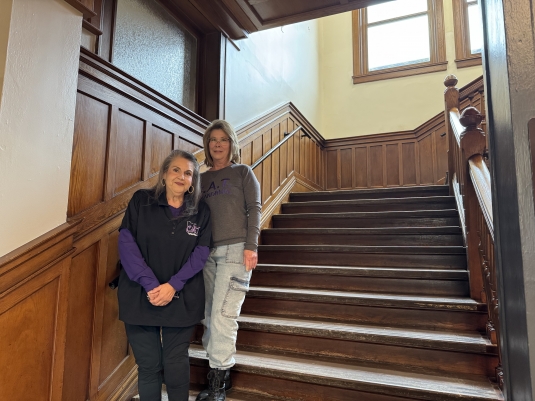
INVESTIGATORS - Kimberly Juarez and Kari Haslip are two members of Coexisting with the Afterlife Team (C.A.T.) Paranormal, a Waseca non-profit organization which carries out investigations and offers consulting services. C.A.T. Paranormal will be giving a presentation at the Waseca County Historical Society the evening of Oct. 30. Pioneer photo by Deb Bently
C.A.T. Paranormal to present at Historical Society
Thu, 10/23/2025 - 2:15am
“We’re not about sensationalism,” says Kimberly Juarez. “We’re in this to help people.”
Juarez is the founder and leader of the Waseca non-profit organization Coexisting [with the] Afterlife Team–almost always shortened to C.A.T. Paranormal. Also active in the group are Kari Haslip, Dorothy Blanco, Jamie Pentico and Jazmin Quevedo.
Members of the group will be presenters at an Oct. 30 session at the Waseca County Historical Society, where they will begin by showing and explaining the variety of equipment they use when performing a paranormal investigation. Juarez and Haslip list off 10 or more types of instruments which help them take a very scientific approach to reported phenomena.
“Most of our equipment is more about debunking things,” observes Juarez. “If there’s a natural, scientific cause for any of the things people are experiencing, we want to find it.”
Despite their best efforts, however, Juarez and Haslip have quite a list of scientifically inexplicable experiences.
“Nothing like they’re always showing in the movies, though,” says Juarez. “We’ve never seen anything like a ‘demon.’
“I’ve never told anyone they should move out of their house.”
She does mention, however, having sometimes suggested that people “take their house back” by burning sage, praying, and communicating their needs to any spiritual “roommates.”
Fellow member Haslip suggests that much of the time, feelings of unease and fear are incidental–that is, no entities have set out to purposely frighten anyone. People simply react with discomfort because they are on unfamiliar ground.
Knowing that, however, seldom helps.
“I get this tight feeling in my neck,” she describes. “And then I know something unusual is going on.”
The two say that, on average, they hear from about one person or family a month asking for answers, assistance, or an investigation. C.A.T. does not have a fee schedule, but relies on people to donate what they can toward the expenses of any work the group does. Juarez clarifies one common reason people reach out is because children are experiencing discomfort or fright.
Having been sensitive to paranormal events since childhood, Juarez says she responds to these as quickly as possible. “I know what they’re probably experiencing,” she summarizes. “The children are seeing things other people can’t see, and they don’t understand, so they become frightened.
“I get there as fast as I can to help reassure them and explain things to them.
“They feel better when they know they’re not the only ones.”
The two hesitate to say anything about work done for private clients, but they describe having carried out investigations in numerous public locations including the county courthouse, Maplewood Park and an area school building.
On Maplewood, the group heard a distinctive call which sounded somewhat like an animal, but also seemed to have been produced by a human. The sound was caught on a recording which was later played for an elder of a native American group. Though the individual first seemed somewhat disinterested in their account, Juarez recalls, his interest intensified greatly when he heard the recording. He then went on to explain native Americans would frequently use sounds like that one as a signal to let others know strangers were approaching.
Also on Maplewood, one of their cameras caught an image which seemed to show an outline of a group of people. The native American elder also confirmed features of the outline–including headwear–were consistent with traditional modes of dress.
While performing one of their investigations on Maplewood, for which they had received official permission and because of which they were able to be in the park after dark with the entry gate locked down below, the group was confused to see a pair of headlights travel up the one-lane roadway, turn around at the top of the hill, then drive back down. “The only people it could have been would be a police vehicle, because of the locked gate,” speculates Juarez. “But when we checked with them, they said the gate stayed locked the whole time.”
In one case while on Maplewood, a member of the group heard a woman’s name. Another member discovered a few days later in a chance conversation that the ashes of a woman by that name had recently been scattered in the park.
In the Waseca County Courthouse, where they have also done a number of investigations, they saw an orb–a glowing ball of light–and recorded some spoken words and phrases. While moving through the building, group member Jazmin Quevedo was given permission to step into the judge’s chambers for a quick look around, but the door slammed before she could enter. She did not attempt to open it, but it was discovered the next day the door had not only closed, but also locked itself.
For the most part, Haslip says, investigations are straightforward efforts to collect information and evidence both with their own eyes and ears, and with the various types of equipment the group has acquired over time.
Only occasionally, she says, are group members frightened.
A few times, she says, team members have been “rushed.” She describes a sensation of fast, invisible motion followed by a perception of being unwanted. She recalls one time when she and another investigator found themselves standing back to back, circling as though they needed to protect each other. “That was a scary feeling,” she says.
But neither Juarez nor Haslip want to send an impression of persistent drama or fear. The incidents described here have occurred over time, and were mingled among a much higher number of quiet hours spent in the dark listening and watching instruments which often gave either indeterminate readings, or very few readings at all. Any feelings of uneasiness or fear are more likely to be caused by animals or people moving around in the dark than by anything supernatural.
When they have found evidence of paranormal happenings, it has often been a sort of residual energy. Juarez mentions one area home where the occupants would find the pots and pans in the kitchen rattling together inexplicably. “It was a new home,” she continues. “No one had ever died in it or anything like that.” Interestingly, she says, “sometimes the energy can be very old. It might go with the land where the house is standing rather than the house itself.”
A case like that one, she suggests, can be handled by simple techniques, usually including speaking plainly to the space and explaining the presence is not wanted.
Juarez and Haslip say if people in the area are encountering something they believe might have paranormal causes, the two of them hope folks will contact C.A.T. using the organization's Facebook page. They also invite people to acquire tickets to the Oct. 30 presentation, which will benefit the Waseca County Historical Society (WCHS) financially. Tickets are available on the WCHS website.