
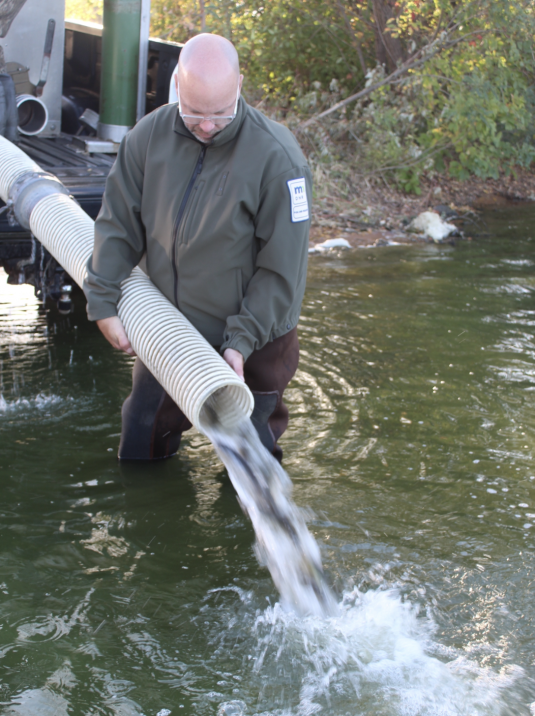
STOCKED UP - Brandon Eder, assistant area supervisor with the Department of Natural Resources fish hatchery near Waterville, in the process of stocking walleye "fingerlings" into Clear Lake this week. Pioneer photo by Deb Bently
Clear Lake receives allocation of walleye
Thu, 10/16/2025 - 2:30am
Hundreds of pounds of “fingerling” walleye were stocked in Clear Lake this week. The fish spent the warm months of the year in a pond at the Department of Natural Resources (DNR) hatchery near Waterville, growing from “the size of an eyelash” to being somewhere between six and nine inches in length, according to Brandon Eder, assistant area supervisor with the facility.
Eder shares that Clear Lake receives walleye during October of odd numbered years, and northern pike in even-numbered years.
Under optimal conditions, this year’s fingerlings are likely to be “keeper” size of about 14 inches or around 1 pound in 3 to 4 years.
Walleye are the state fish, Eder points out, and are a favorite with anglers for many reasons starting with the variety of ways they can be hooked, including with a bobber or jig, trolling, and through the ice. He says not only are they an attractive fish, they can be an exciting challenge to catch. But perhaps most importantly, “they have a fantastic flavor” when prepared.
The process of producing this year’s fingerlings, which have a target size of 25 to a pound, began soon after the Cannon River waterway was clear of ice.
Eder and other fishery staff members used electrofishing to capture both male and female walleye who move from Lake Tetonka into the Cannon River as spawning time approaches. They “milked” the fish of their reproductive cells and returned the adults to the water unharmed. The fertilized eggs were placed in an elaborate network of containers with gently circulating water. As eyelash-size fry hatch and swim away from as yet unhatched eggs, they are drawn through tubes and gradually arrive in a large tank. As more and more fry arrive, they create the appearance of a cloud in the water.
The millions of hatchlings are distributed in different ways.
Many are taken directly back to select lakes shortly after hatching. In the case of natural reproduction and of stocked fry, Eder says the estimated survival rate is only 1 to 5 percent, but the number of fry is large enough that those odds are sufficient to sustain lake populations. Eder summarizes the factors leading to the attrition as: “They have to find food, and they are food.”
He lists a number of reasons fry placed in the hatchery ponds have a higher survival rate. Perhaps foremost, there are no predators. The shape and size of the pond, and sometimes intervention from fishery staff, help regulate the temperature and oxygen levels in the water. Natural food levels are supplemented. Birds and other unavoidable predators are discouraged–loud noises are used to frighten them away and sometimes physical barriers may be employed, for example twine strung across the surface of the water.
“So we have a much higher survival rate because we’ve invested a lot more resources,” Eder says. “In other words, the fingerling fish are much more expensive.”
For that reason, only a relatively limited number of area lakes regularly receive the fingerlings, namely Clear, Fountain, and Beaver. He explains that strong panfish populations in these three lakes lead to unsuccessful survival rates when stocking fry. In other words, too high a percentage of them become food before they have a chance to become fish. When there are sufficient numbers, Lakes Ballantyne and Frances are also stocked with fingerlings.
The delivery of the fish, Eder says lightheartedly, “is not an elegant process.”
It begins with emptying the rearing pond, netting the fingerlings, and placing them in transportation tanks. The hatchery has two portable tanks, one mounted on a truck and a second, larger one, on a trailer. The process requires considerable physical effort since the fingerlings are drawn into an enclosed “trap,” netted out, and deposited into buckets which are then carried to the tanks and emptied.
With hundreds of pounds of fish along with the water needed to transport them, that gets to be quite a few bucketloads, and so quite a few trips carrying them back and forth.
Harvest of walleye from on-site ponds typically happens at night. Fingerlings are transported from the pond to raceways inside the hatchery overnight and are transferred back onto the tank truck in the morning. Aerators in the tanks deliver extra oxygen to the concentrated populations until they are delivered to lakes the next morning, usually within 12 to 15 hours.
Once the fingerlings are in the lake, Eder points out, the numbers game continues.
“But hopefully we’ll have a strong survival rate,” he says, “and anglers will be pulling these walleye out of the lake for years to come.”