
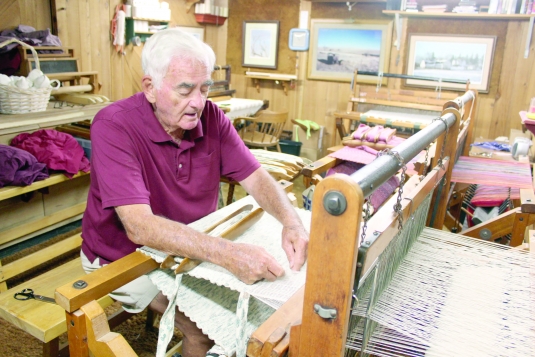
Wasecan Ralph Keyes works at one of the century-old looms he uses to make rag rugs. He regularly sells his finished products in a number of venues, including Waseca's farmers' market. Pioneer photo by Deb Bently
Resuscitating a dying art
Wasecan Ralph Keyes makes rag rugs on antique looms
Wasecan Ralph Keyes makes rag rugs on antique looms
Tue, 09/30/2025 - 8:05pm
Ralph Keyes observes there are advantages to specializing in a dying art.
One is that people are excited when they see it.
“I hear it all the time,” says the Wasecan, who makes rag rugs using looms which were built prior to 1930. “‘Mom used to do that,’ or ‘The lady next door used to make those.’”
Another is that there is no lack of available equipment.
Despite having numerous sales and publicity venues, he currently does not know of any other crafter who makes rag rugs. He has also come to own eight looms, nearly all of which have been rescued from decades-long storage in someone’s barn, attic or garage.
“Every once in a while I get a call,” he comments. “Someone says they have an old loom and wonders whether I’ll be interested.
“Or they want to know if I can help them get it back in working condition.”
Keyes, 88, has lived in Waseca since the 1970s, when he and his wife Audrey moved to town so he could take a position as the school district’s assistant superintendent. Audrey worked as a home economics teacher. A few years later, Ralph ran for county commissioner and held office for about 16 years. After leaving government, he operated an appraisal business for 13 years, eventually retiring around the year 2000.
About then he happened to think of the loom once owned by his father, Raymond, who was a mailman in Sleepy Eye during Ralph’s childhood. After his workday was over, Raymond would make custom rag rugs for customers who supplied their own fabric already torn into strips, sewn into long runs, and rolled into balls–almost like yarn, but much, much thicker.
After Raymond’s death, Ralph’s sister had taken the loom, but admitted she had made no use of it and consented to give it to Ralph in exchange for a few tasks.
Because the looms Ralph works with occupy floor space about four feet on a side and stand about 4 feet high at the tallest, they must nearly always be disassembled in order to be moved. He brought his father’s loom to Waseca and set it up in his basement. It still stands there, and now has three other looms for company.
Another advantage to practicing a dying art is that he has been able to purchase each one for about $100 or less.
Most of his looms are labeled “Union Loom #36, Boonville, N.Y.” According to various online sources, the Union Looms manufactory was active from 1916 to about 1930, when the Great Depression put it out of business. Reportedly, the company made only three types of looms–a small “home” unit, the #36 style designed especially for making rag rugs up to about 25 inches wide, and a high-end custom loom, capable of weaving projects 45 inches wide.
At its height, the company employed 160 people. The #36 seems to have been its most popular; about 40,000 were produced and sold around the country.
Ralph admits it was a labor of love to reassemble Raymond’s loom and prepare it for use. That is, the complexity of the equipment, its disassembled state, and the many steps required to get the 360 “warp” strings in position before weaving can begin do not inspire dreams of wealth and fame.
“You can’t think of it as work,” he comments. “It has to be something you’re doing because you like to.”
He remembers when he wove his first rug nearly three decades ago, he was nervous about it. “I was always wondering if I was making a mistake,” he recalls. “I worried about whether the edges were even, and if I was keeping it tight enough.”
Nowadays, he says lightheartedly, “I just slam it into place.”
By “slam,” he means the motion of pulling the “beater”--the loom piece's actual name–against the material.
Another advantage to his hobby, he points out, is the different ways it gives him exercise. “Beating” is perhaps the most obvious, but there is also the persistent motion of feeding the “shuttle,” a sort of elongated wooden spool, back and forth.
“It’s probably lengthening my life,” he suggests.
Yet another strength of his hobby, he goes on, is that “the raw materials appear on my doorstep.”
People who know he makes rugs drop off fabric by the boxful, he relates. They also deliver it to him at his usual booth at the Waseca farmers’ market, or tell him about it and he volunteers to pick it up. He also visits thrift stores to keep his eye open for likely cloth.
“A fitted sheet, a flat sheet and two pillowcases,” he declares, “are just the right amount of material for one rug.” The combination, he explains, makes a finished product about 54 inches long.
Probably his favorite type of cloth to work with, he says enthusiastically, are chenille bedspreads. The bumpy fabric, he explains, creates a soft, bumpy texture in the rug. “People like it,” he says. “They always sell really fast.”
A favorite no longer available to him, he recalls, were “trimmings” sold as scrap by the Faribo Woolen Mills. The company would make gigantic runs of fabric, he describes, and then cut edges away to prepare for hemming.
“Those strips would just go on and on,” he remembers. “No need to tear them apart like sheets, no need to sew the strips together. And they made nice rugs.”
Among the types of raw materials he can work with, Ralph goes on to say, are discarded curtains, tablecloths, bedspreads and sheets–with flannel sheets being particularly good. “Anything that can be torn into long strips,” he describes. Stretchy fabrics are not useful for weaving, and shorter garments like shirts do not tear apart smoothly into strips.
He makes a fair number of rugs from blue jeans. “They make very durable finished rugs, but they are more work to prepare,” he comments, noting that the pockets must be removed and the various seams dealt with.
In addition to farmers’ markets in Waseca and Mankato, Ralph also finds sale venues in Florida, where he and Audrey spend part of the winter. He notices distinct preferences in the two markets.
One highlights the differences in the soil. “Up here, people tell me my rugs are too light-colored,” he says. “Down there, they tell me they’re too dark.”
In general, people in Florida seem to use fewer rugs, he comments, so he makes smaller items like table runners and, in one case, a piano bench cover.
Another smaller product he finds a market for is a rug roughly two feet on a side.
“The wives tell me their husbands wear out the carpets kicking and stamping their feet when they watch the football games,” says Ralph. “So they put it in front of their chairs to protect the carpeting.”
Ralph says “I wish I knew” when asked about how many rugs he’s made over the past three decades, but estimates each typical-sized rug requires about four hours of work–two to tear the fabric into strips and then sew the strips end to end and two to weave them.
That estimate is also hard to tie down, since he seldom works on any one task for more than 30 minutes at a time. “If I feel like I’ve done enough of this one thing, I switch over and do another.” That’s why, he says, there are four looms in his basement: he persistently keeps at least four projects going at once.
Being one of few people acquainted with looms has brought him a certain amount of notoriety. He gets calls even from nearby states asking whether he can help rehabilitate a loom or teach someone to use it.
He has a regular gig at Farmamerica, where he sets his loom up in the shade of the apple tree on the 1800s farmstead and demonstrates what it takes to weave a rug. He says he especially enjoys watching children’s faces as they see all the steps of the project come together, or are fascinated by the slamming sound and motion of the beater.
He apparently also enjoys the unpredictability that comes along with the requests for help.
“One lady asked me if I would teach her how to weave,” he recalls. “I got to her house and she showed me the loom–it was all in pieces. Instead, I got a good start on putting the loom together.”
One lesson he is particularly looking forward to is in response to a request from his 26-year-old granddaughter, who said she would like to learn to weave. “I got a loom for her, and I’m getting it ready,” he says. “I’ll be delivering it to her sometime soon.”