
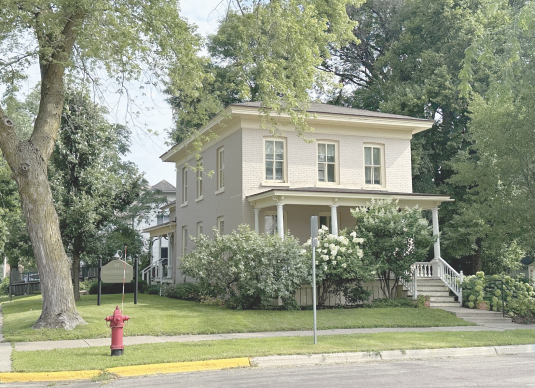
MERCHANT HOUSE - Built in 1868, the historic Bailey-Lewer house at 401 Second Avenue Northeast in Waseca, is the oldest existing house within Waseca County. Structural problems have officials studying the best way to facilitate upgrades. Pioneer photo by Amelia Roessler
More than a research library
Working to keep the Bailey-Lewer house a home for peoples' memories
Working to keep the Bailey-Lewer house a home for peoples' memories
Thu, 08/07/2025 - 2:30am
The 157-year-old Bailey-Lewer house in Waseca is seeing some new — and needed — changes.
A historic house, it has a foundation laid in a time when construction practices were rather informal. Waseca County History Center database manager Elizabeth Anselmo said a structural engineer informed them the building is leaning three inches toward the southwest corner.
“When you walk on the second floor, it has that fun house floor kind of feel,” she said.
The house, located at 401 Second Avenue northeast, has been on the National Register of Historic Places since 1994 and belongs to Waseca County, with a 99-year lease to the Waseca County History Center through 2099. It is the oldest existing house within Waseca County and is a typical example of the houses built by Waseca merchants during that period. It also was owned by a horse thief and one of the city’s founding fathers.
The Bailey-Lewer house is known as the home of Waseca pioneer Philo Bailey, who owned the Italianate-style two-story brick house built by “Date” Smith in his late 30s. In his time, Smith was also well known as a horse thief.
Two years after he built the home, Smith was run out of town after being threatened by a Waseca lynch mob. As the story goes, Waterville was known for a gang of horse thieves operating in Iowa and Minnesota, and Smith was allegedly a Waterville farmer. Smith barely escaped with his life and sold all of his property in 1870, including his two-year old home.
Philo Bailey opened the first hardware store in Waseca County in 1857 in Wilton but moved his store to the city of Waseca when the city was founded in 1867. Bailey lived in his store until 1872 when he bought the 13-room house on the corner. As the city grew, many prosperous merchants built houses primarily in the northeast quarter of town, the location allowing merchants to reach the commercial sector without crossing railroad tracks.
Bailey, in addition to being an active merchant, was also involved in many civic affairs. He was a state representative in 1862, county treasurer in 1864 and 1865, senator in 1877 and 1878, an alderman from the second ward of Waseca in 1893 and county commissioner from the Waseca district from 1895 to 1897. He also took a prominent part in supervising the construction of the county court house.
After Bailey’s death in 1907, the home was owned by H. F. Lewer and remained in the Lewer family until purchased by the Waseca County Historical Society in 1991 for $7,000. Anselmo said that was practically giving it to the Historical Society.
Now, the History Center is working to stay ahead of the curve and keep the building in good shape. Because of the “funhouse feel,” Anselmo said the county moved 227 boxes of probate files that had been stored on the second floor of the house into an annex building.
“Then we will be kind of reviewing what we’re storing on the second floor and determining whether that will stay in this building or will move over to the museum building,” Anselmo said. “Just trying to move things off the second floor, like the yearbooks and things that people will find interesting and want to be able to access when they’re here visiting.”
Paper artifacts are mostly stored in the Bailey-Lewer house, with the exceptions of photographs and physical artifacts kept in the museum building.
Anselmo was hired in May, when executive director Joan Mooney retired along with two research librarians. She said it was good timing for her to step in and try to reinvision the space of the Bailey-Lewer house.
“It was the right time to come in and give the house a little bit of a refresh, and that involved moving some furniture over to the museum building for some functionality,” Anselmo said.
She says her biggest goal is to provide access and functionality for people to come and use and appreciate the historic house. By providing workstations and space for researchers and curious minds, Anselmo hopes to encourage people to access what the library has to offer.
“Allowing people the space to reminisce is really cool,” Anselmo explained. “There are a lot of great resources here that maybe people aren’t aware of. Besides microfilm, we have census, we have birth and death records up to a certain date. There’s a list on our website of a lot of the things that are accessible here.”
Anselmo said one of her favorite things to look through are the old phone books, which gave addresses and so allow people to and see where ancestors used to live. Also popular are older yearbooks where people’s high school pictures allow them to relive those years and also remember previous classmates.
“I love this building. It’s very important to the community and it’s important to the museum that we’re good stewards of the space. So we’ll do whatever we can in conjunction with the county to make sure that it’s here for a long time,” Anselmo said.
Being good stewards involves making tough decisions regarding what needs to be kept, what’s important for the county's history and what needs to move on. For example, Anselmo said they have newsletters from genealogy organizations going back into the ‘90s that don’t necessarily have anything to do with Waseca County.
But if something doesn’t stay, it doesn’t mean it gets thrown away. A lot of things are given to other historical societies, offered to citizens for free or made sure they get a good home.
“Unfortunately, we do recycle some things,” Anselmo said. “There’s always the option to reach out to other historical societies. I know we have a fair amount of things that are not necessarily Waseca County, but could be Steele County. So we can always reach out to them. And then offering items for free, like we have a desk that’s going away for free or other furniture that we need to move out of the space because of its weight.”
Because of the structural challenges, the house is currently only open by appointment. Previously, the building was open on Tuesdays and Fridays from 9 a.m. to 5 p.m., something Anselmo said she would like changed to being open four days a week, coinciding with the museum’s open hours.
According to Anselmo, there is a building committee with the museum made up of some board members who have been able to talk about the issues and plans moving forward. She added some of those plans include the option of a possible capital campaign to cover the cost of repairs and updates.
“So many things are still up in the air,” Anselmo said.
For now, the county and museum have decided to let the house sit for a year and see how much change in the structure happens in order to help inform them of needed changes going forward.
“I think it’s important for people to know that our collection is accessible online through the website. We have a hub where we have 270,000 entries from our collection and people can view those at any time. If there’s something that was indexed and on microfilm, they can either come in or submit a request to have that research request fulfilled,” Anselmo said.
While Anselmo said they are still in transition from moving files and historical documents around due to weight and finding room for people to do research, she added that they’ve come a long way.
“It feels very welcoming,” she explained. “It’s going to be a process, and that’s true with what’s going on with the structure itself, but the house is not going to fall down, there are no cracks in the ceiling. So we’re kind of, we think we’re ahead of the curve on what’s happening to the building.”