
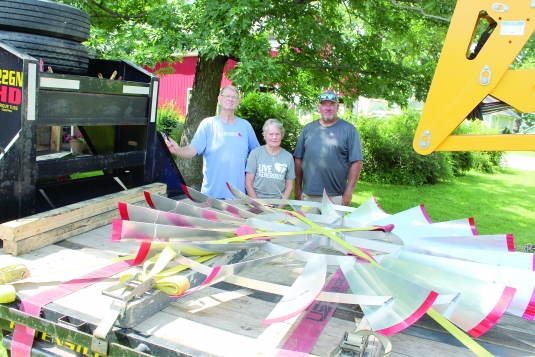
BIG FAN - Property owners Dan and Cheryl Forrest with Mark Petersen of Breezy Mills, the Milford, IA, company which made the fan blade that was recently installed on the Forrests' Waseca County home place. Pioneer photo by Deb Bently
Windmill rehabilitation restores history
Thu, 07/31/2025 - 3:00am
From the time she moved back to the farm where she spent her childhood, Cheryl Forrest felt as if something was missing.
Standing on the yard of the farmsite where she and husband Dan have lived for the past 11 years is an impressive 70-foot-tall windmill tower–the old-fashioned sort which used wind power to pump people’s water. Like many all over rural Minnesota, it had stood for decades without a fan blade at its top.
On July 8, though, the tower became “whole” again. Not only was an 8-foot-diameter fan blade attached to the top, it was joined by a “tail,” the flat extension which uses aerodynamics to keep the blade facing into the wind.
On the tail is the message “Lee, Est. 1870.”
Cheryl’s great-grandfather was Aslak Knutson (A.K.) Lee, who was born in Norway and emigrated to the United States because no land was available back in his family’s home “kommune” of Vinje. In 1870, he and his wife Betsy purchased land five miles north of modern-day Waseca along Highway 13 from Knute Engebretson, who had become the owner during pioneer days by the process of “homesteading.”
At the time of A.K.’s purchase, Waseca had been a county for 13 years; its citizens had only recently voted to move the county seat from Wilton to Waseca. With A.K. and Betsy was A.K.’s father, Knudt Aslakson Lien (pronounced “lean”). A.K. is mentioned in “Child’s History of Waseca County,” where he is described as “an energetic, prosperous farmer.” He and Betsy eventually raised 13 children.
Direct descendants of the family have owned and lived on the property ever since, although the amount of farmland associated with it has risen and fallen over time.
The only child of her parents Alvin and Dorathea Lee, Cheryl was born in 1947 and remembers well the times when both the farm and household depended on the windmill for their water. Initially, a wooden handle could be turned so that water from the wind-powered pump would be diverted to one of two cisterns: One supplied the barn for use by livestock or chores being accomplished there. The other filled a cistern located in the residence’s basement.
The water would be at a temperature below 60 degrees Fahrenheit, delightfully refreshing to drink on a hot day, and also cool enough to help preserve fresh milk in the dugout below the windmill.
Cheryl remembers the house had two hand pumps in the kitchen. One drew drinking water from the basement cistern filled by the windmill. The other drew rainwater which had been diverted from the house’s gutters. Clear and clean-looking, the rainwater was used for washing clothes and other cleanup tasks. A ceramic-lined bucket in the kitchen was kept full of cool, freshly-drawn well water; it had a matching dipper which every member of the family drank from.
“It didn’t meet the standards people would have today,” she remembers, “but it worked very well as far as we were concerned.” She says there was a similar bucket at the one-room school she attended during her elementary grades.
“We had to pump the water for everything by hand,” remembers Cheryl. “If it needed to be warm, we heated water on the stove and mixed it in to bring the temperature up.” Whether for a bath or washing dishes, she says that was the process.
As for the classic meaning of “indoor plumbing,” a flush toilet was a bit longer in coming. Cheryl remembers using a three-seater outhouse up until she was 13 years old.
But for any inclined to feel sympathy regarding her rustic childhood, she observes “It was a lot of fun.” Cheryl remembers being put at the wheel of a tractor at age 5. Her father, Alvin, who had always been in somewhat poor health, died in 1953. Her mother married Ray Sutter, who remained her partner for the next five decades, in 1954. The farm also kept a hired man who had his own living space in the house.
Through it all, the homestead housed pigs, dairy and beef cattle, horses, sheep, chickens, and dogs and cats. “There was work to be done,” she observes. “So we did it.”
Cheryl says she was called upon to feed animals, take care of assigned chores, and help her parents with any type of job, whether in the barn, garden or house.
“We were very poor,” she recognizes in hindsight. “But everybody was, so there was no stigma about it.
“When we needed money, we hauled some corn to town and sold it.”
She also remembers plenty of time for play. Conveniently, her second cousin Dennis Lee lived on the farm across the road. “We played nonstop,” she recalls.
Cheryl says the windmill blade was removed some time in the late 1950s, when a newly installed electric water pump was one of the earliest steps toward modernizing the farm.
When the time came, Cheryl attended Waseca’s Central High School, graduating in 1965. Dan, now her husband of 55 years, graduated from Sacred Heart High School the same year. The two got summer jobs in local businesses, Cheryl working for Herter’s mailing catalogs; Dan at Brown Printing. They met in 1967 and married in 1970. Cheryl attended Gustavus; Dan went to St. John’s. Both earned degrees as teachers and went on to get jobs at Twin Cities area schools.
They lived and raised their two children, Sean and Meghan, in a home in Burnsville. Times being what they were, Cheryl became a stay-at-home mom while Dan continued working as a teacher. The years marched on; the children graduated high school in the early 1990s. Cheryl and Dan became grandparents. Dorathea and Ray continued to live on the home place, gradually experiencing declining health. Soon after Ray’s death in 2010, Dorathea decided to move to a lower-maintenance setting in town, leaving the home place standing empty.
In 2014, circumstances invited Cheryl and Dan to move “home.” Even before moving back, they had been giving the aging farmstead some tender loving care, remodeling both the barn and granary while there was still time before they reached the point of no return.
Each of those projects came at prices unimaginable to the lifestyle of her childhood years, but Cheryl says saving the buildings and giving the homestead a facelift were the right things to do.
In keeping with that philosophy, the couple had been thinking about rehabilitating the windmill tower for a year or more when they attended the KOWZ farm and home show this past April. Among the vendors was Breezy Mills, a Milford, Iowa, company which specializes in windmills.
As the couple discussed whether to hire the company, Dan remembers making the joke that they should do it–as long as Cheryl was willing to go without birthday, anniversary or Christmas presents for the next decade or so.
Given the height of the tower, Breezy Mills recommended the company’s largest standard blade size, eight feet in diameter. After agonizing a bit because of the transformations in the family surname over time, Cheryl decided to use the longest-standing version of the name, “Lee,” and the year 1870 as the text on the tail.
The new aluminum blade is for show only, since it is not connected to any sort of mechanism. Aerodynamics turn it so it faces into the wind; Breezy Mills guarantees it to withstand winds up to 90 mph.
After standing “topless” since the 1950s, the tower had a blade again after a two-man crew went up on a mechanical lift and put it in place. The process took a few hours, although it also required renting a special lift because Breezy Mills’ lift could not reach 70 feet.
Cheryl and Dan say it feels good to see the blade spinning up there. “It’s finally whole,” said Cheryl. “I’m glad we did this.”