
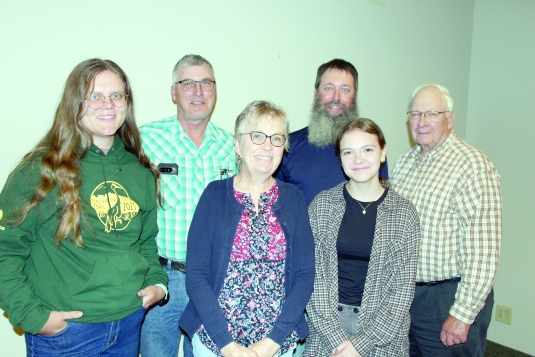
Speaking up and listening in on behalf of Waseca County during a recent USDA information-gathering session were Waseca County Soil and Water Conservation District staff members Cammi Nordmeyer (far left), Mark Schaetzke (back right), and the agency's summer intern, Jayme Sandbeck (front right). Pictured with them are interested farmers Dan and Debbie Roemhildt and Marvin Guse (far right).
Conservation professionals address funding
Thu, 06/26/2025 - 1:00am
The Mankato office of the United States Department of Agriculture invited farmers, rural property owners, and soil conservation professionals from Blue Earth, Faribault and Waseca counties to a local work group (LWG) meeting the evening of June 16. About 40 people gathered at the Pemberton community center to offer input regarding what the USDA should prioritize as it divides out funding for the myriad programs it supports.
District Natural Resources Conservation Service (NRCS) conservationist Jessica Beske told those in attendance this was their opportunity to provide input which might have an influence on future statewide decisions.
Some in the room expressed displeasure that certain USDA programs were paused this year. Waseca Soil and Water Conservation District (SWCD) manager Mark Schaetzke commented on the number of applications which were not funded. “A lot of them should have been funded,” he stated. “They were good projects that provided a lot of public good.”
Though not in a position to defend or explain the entire USDA organization, Beske observed “This is the first year in my experience that we’ve had a backlog.” She mentioned uncertainty at the federal level regarding how consistent funding might be, and suggested that may have been part of the problem. “Don’t judge based on this year,” she suggested.
SWCD staff offered numerous suggestions.
One was that additional priority should be given to funding restoration of windbreaks, since a fungal needle cast disease has been found to be killing spruce trees in the area, especially since spruce had previously been among the most recommended trees for windbreaks.
After a discussion about protecting streams and rivers, the group consensus was that projects which “impact a direct water source” should be given priority over those which do not.
The group also placed emphasis on outreach, noting that numerous farmers continue to use conventional tillage and management methods even on “HEL”--highly erodible land.
Group members also brought up wind erosion, pointing out that “black out” winds seem to be occurring more often. They regarded land left bare after the planted crop had been drowned out as a major contributor, and suggested emphasis should be placed on getting a cover crop in such locations.
Another element of the conversation involved compost structures. Various individuals noted the standard USDA plan includes attaching a roof and laying nine-inch-thick concrete. The roof, the group agreed, decreased the structure’s efficiency, while nine inches of concrete was more than necessary and added expense.
Also shared during the work group session were priorities the USDA has assigned to the four major categories of agricultural projects within Minnesota. Provided here are the names of the categories and the top two priorities for each.
Cropland: Weather resilience, ponding and flooding. Field sediment, nutrient and pathogen loss.
Forestland: Degraded plant condition; plant structure and composition. Pest pressure, plant pest pressure.
Farmstead: Storage and handling of pollutants; nutrients transported to surface water. Weather resilience, ponding and flooding.
Pastureland: Livestock production limitation, feed and forage balance. Weather resilience, ponding and flooding.