
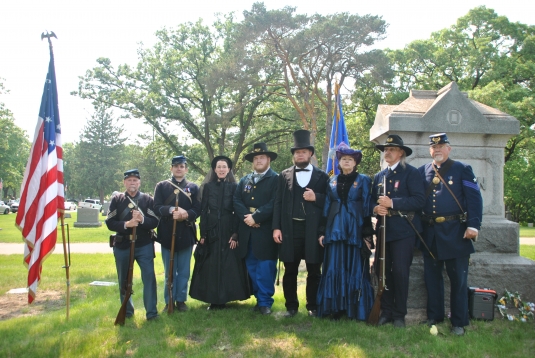
Sons of Union Veterans of the Civil War (SUVCW) presented a May 31 ceremony at Woodville Cemetery in Waseca honoring John Oleson, who served with the First Minnesota Heavy Artillery Regiment in Chattanooga, Tennessee. His service ended in September of 1866, after the formal declaration of peace by President Andrew Johnson. After returning home, Oleson lived to the age of 94, dying on Jan. 11, 1940.
History group honors county’s last living Civil War veteran
Thu, 06/12/2025 - 12:00am
A small crowd gathered at Woodville Cemetery on May 31 for a ceremony which called history to mind. The Sons of Union Veterans of the Civil War (SUVCW) brought together reenactors who represented a time in the late 1800s, not only by their dress, but by their use of words and behaviors which would have been common at the time.
The ceremony was similar in format to a funeral, lasting about 30 minutes. Roughly 25 people attended. The reenactors presented two ceremonies that day; the other took place in Albert Lea. Also participating were members of “Boy in Blue,” a Mankato-based organization which also focuses on civil war history.
According to Gary Carlberg, camp commander of the organization’s Minnesota branch, the SUVCW carries out similar ceremonies across the country. In Minnesota, they have been enacted in more than 80 percent of the state’s counties, sometimes after lengthy searches to accurately identify and locate the correct name and grave. Carlberg explains many civil war veterans were immigrants originally born in another country whose names may have been spelled as many as four different ways across time.
When it comes to the SUVCW’s efforts to verify the service and find the graves of union soldiers, Carlberg says a challenge directly interrelated with Minnesota history is the number of civil war soldiers who moved to the state beginning in the 1870s when, after the Dakota uprising, nearly all indigenous people were forcibly removed and their former lands were made available for “homesteading.” Carlberg explains that, while most were required to live on land for five years before being granted ownership, union veterans could be eligible in two.
In the case of Waseca County, Carlberg says the search was quite straightforward. John [originally Johann] Oleson had arrived in Waseca County in 1857 with his parents and seven siblings; he was in his early teens at the time and worked on the family farm driving oxen teams to “break ground” for farming.
At the age of 20 in 1865, he enlisted with the First Minnesota Heavy Artillery Regiment, which grew to include about 1,700 soldiers before being sent to Chattanooga, Tennessee. The regiment maintained and manned heavy guns there as a defensive tactic. Chattanooga was originally in Confederate territory and had been taken by union forces; the heavy artillery regiment was stationed there to keep the Confederate army from reclaiming the city. The attack never occurred, and so the regiment never saw battle.
Oleson returned home to Waseca County. He never married and had no children. He lived to the age of 94, dying in January of 1940.
“Our research is six feet deep,” quips Carlberg. “We are looking for verification of the name and of their service. We’re not looking for the soldiers who earned the most medals or fought in the most battles; we don’t work to find out anything about their lives after the war or their descendants.”
In addition to the ceremonial acknowledgment of the last living veteran, the SUVCW has made a project of acquiring headstones for any unmarked graves of union veterans. Carlberg shares proudly that the Minnesota camp has arranged to have the Veterans Service Administration (VA) supply more than 200 headstones at cemeteries across the state. He explains the VA will provide headstones for veterans at no cost; the challenge is acquiring the necessary documentation.
The funeral-like ceremony, Carlberg goes on to say, provides the military honors many civil war veterans never received.
“We think of it as doing something that should have been done 100 years ago,” Carlberg comments. “We take people back in time. We hope it makes them think about how it was to live, work, and fight in those days long ago.”
Along with the costumes and behaviors, the reenactment is loaned authenticity by a “volley” of gunfire using historically accurate rifles which use black gunpowder.
“When the ceremony is over, we bring people back to the present and they can turn on their cell phones,” says Carlberg, who invites anyone interested to visit the SUVCW database at www.suvcwdb.org.