
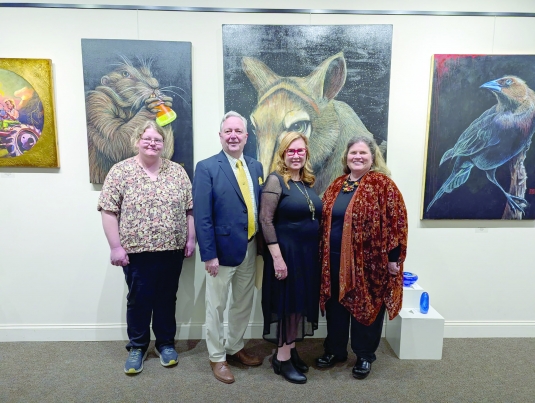
From left: Olivia Hoppe, Mikhail Rostislavovich, Mary Catherine Solberg, and Penny Vought.
Solberg and Hoppe Exhibit
Wed, 05/21/2025 - 7:50pm
The Waseca Art Center hosted a reception on Thurs. evening, May 1 for an exhibition of artwork by Olivia Hoppe and Mary Catherine Solberg, two artists from far afield.
Considering the pouring rain on Thurs. evening, the reception was surprisingly well attended.
Mikhail Rostislavovich, current president of the Waseca Art Center (WAC), kicked the evening off by introducing WAC board members: Brad Donner; Katie Youngberg; Missy Donner, past president; Jeanne Sexton; Caitlin Roberts; Ann Staloch; Commissioner Brad Milbrath; and Christy Easton, director of education and programming; and Penny Vought, vice president; and Diane Beckmann.
Rostislavovich then introduced the two featured artists: Hoppe and Solberg.
Solberg spoke about her work over the years, explaining that the paintings fall into various categories. What Solberg calls “swim girls,” are paintings that are “less about swimming than about transformation.” The religious iconography of her Catholic upbringing resulted in a series on icons, in which she depicts people or animals, such as a squirrel or a groundhog, and elevate them to the sacred level using gold leaf. A collection of animal paintings is deeply personal for Solberg, because her inspiration are photographs taken by her late brother, Jim Solberg. In these paintings, Solberg always adds a personal touch, such as the piece of candy corn in the painting “Groundhog Devouring Candy Corn.”
Solberg enjoyed creating art all her life, but initially took the 'sensible' approach and avoided making a career of it. “I always was good at drawing faces,” said Solberg, who remembers drawing a caricature of one of her teachers. “But you can't make money doing art, right?” Solberg became a land surveyor, but always found herself wanting to squeeze art into her schedule.
Solberg opened a gallery in La Cross, Wis. and supported other artists. Finally, her husband, Patrick, an architect, told her she should make art her full-time work, and he would support her.
Each of Solberg's paintings has a story behind it. “The Pacifier” portrays the daughter of a friend, who sent her the photo. “I saw that picture, and I got up that morning, and I thought, 'She's so badass.' I just started painting, and I painted her straight through. I was so inspired,” said Solberg. “I'm all about women and […] women grabbing their power and having their moment, especially young girls. It just sort of said a lot of things that I feel inside.”
Many of Solberg's paintings start with a thin layer of plaster to create texture on the canvas. Solberg said she's sure others in the art world must be doing the same thing, but she came upon the technique through happenstance.
“Part of my goal is to make it feel ancient and modern at the same time,” Solberg said. “I'm really inspired by the Renaissance. So I want to have that sort of vibe that this is old and yet new.”
She wanted to use oil paints, but found she was allergic to some of the colors. When she discovered Sennelier oil pastels, she fell in love. “They're so fabulous, and I've got millions of them,” said the artist. Oil pastels are another tool Solberg uses to create the aged effect she's looking for. “They skip over the crevices just that little bit, so the [background] comes through, whereas, if I used thick oil paint, that would be saturated in.”
Solberg's paintings aren't exclusively created with oil pastels though. “I break the rules,” said Solberg. Many of her paintings are a combination of traditional oil paints, acrylics, and oil pastels. But it's the fixative she uses between the layers that allows her to combine different mediums without compromising the integrity or longevity of the work. Because she has to let the layers dry, Solberg normally has two or three paintings in progress at once. She finishes the paintings with a lot of varnish, so that, even if they sit out in the rain, the works won't be harmed. Solberg said, “We had one outside on our pole barn for years.”
Solberg's studio in northeast Minneapolis is open by appointment, every second Saturday, and for events. A number of galleries are also representing Solberg. Information concerning Solberg's work, the galleries that showcase her work, and upcoming events can be found on her website: www.marycatherinesolberg.com.
Although Hoppe declined to speak publicly at the reception, she was happy to answer questions as people viewed her work in the Beckmann Gallery.
Hoppe, of Miltona, Minn., often creates her own canvases from items located on the farm where her husband, Frank, grew up, and which the couple are now purchasing. Gourds, cow bones, wood, and wasp nests, which she soaks and flattens, are all canvases to Hoppe.
Of the gourds, she said, “When I was a kid I went to the Riverboat Festival in Aitkin. There was a gal there that was doing gourd art and she gave me a couple of little gourds.” The young Hoppe thought, “Well, these are fun!” She cut the gourds open to get the seeds and started planting them. “Now I have gourds everywhere,” Hoppe laughed.
Hoppe grows many types of gourds in her garden, which she replants each spring. She said, “And they all cross pollinate.”
On the former wasp nests, Hoppe has depicted objects from the farm of human construction, such as barns and antique vehicles. “[The farm] has been in the same family for decades. Well, you know farmers; they don't throw anything away,” she laughed. The barn wood frames around the wasp nest drawings were made by a friend of hers, of whom Hoppe said she hates working with barn wood, “but I will for you.”
Hoppe started using wasp nests when a friend asked her, “I have some wasp nests. Could you use them?” Hoppe didn't know, but she was willing to experiment. She discovered that the material of the nests was tough, “But without priming it, you can't really draw on it without tearing it.” Hoppe takes the nests apart and reassembles them to create canvasses, after which she prepares them with layers of acrylic primer.
Now that she's discovered how to work with them, Hoppe collects wasp nests herself.
Is it dangerous to harvest wasp nests? “They make a new nest every year,” said Hoppe.”But just in case, go out when it's like 20 degrees. If there is [a wasp] in there, it's very slow.”
Besides using acrylics and colored pencils, one of Hoppe's mediums is found on the farm, too. Hoppe makes her own ink out of black walnuts; she allows the walnuts to dry with the hulls on, and then boils the hulls in water to create ink. “You've got to wear gloves; otherwise you end up with brown hands,” said Hoppe. The ink lasts a long time, and it can be used to create a pale wash for the background in a watercolor style, and then in a more concentrated form to create dark lines and silhouettes.
Hoppe often depicts items that either grow or are found on her farm, like mushrooms, flowers, butterflies, and cattle. One display of poisonous mushrooms on a group of gourds had tiny skulls hanging from it.
Of an American goldfinch she painted, Hoppe said, “They just love to visit!” Hoppe attributes the number of visiting goldfinches to the number of thistles on her farm; thistle seeds are a favorite with goldfinches.
Hoppe doesn't have an art gallery. “I just work from home,” she said. “I go out and mess with the garden and take care of the critters,” by which she means cows, pigs, chickens, and geese. When she's not busy gardening, tending animals, or canning the produce she grows, she creates art.
Visitors of the WAC greatly enjoyed the work of both artists on Thursday evening.
Solberg's and Hoppe's artwork will be on display throughout May at the WAC, which is open Tues. - Sat., 12 p.m.- 5 p.m.