
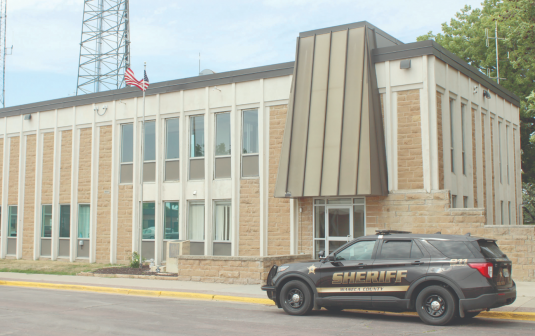
OUTDATED - Built in the late 1960s, the Waseca County jail has already outlasted Department of Correction expectations by 25 years.
Waseca county jail forced to upgrade
Mon, 08/07/2023 - 3:31pm
After a regularly scheduled inspection of the Waseca County Jail, the Department of Corrections (DOC) informed county leadership that the facility risks being downgraded if certain improvements are not made before next May.
At this time, the county jail has the capacity to hold more than 25 prisoners and requires about 8 staff members to operate. Typical daily occupancy, according to county administrator Michael Johnson, is about 9.
At this time, the facility is listed at class 3, a “jail,” which is authorized to hold prisoners “365 days a year,” according to Johnson. Statute specifies a class 2 facility as a “lockup,” and authorizes it to hold prisoners for no more than 90 days. Class 1 is a “holding” facility, not meant to keep incarcerated individuals for more than 72 hours–essentially long enough for them to take part in preliminary courtroom activities before being transferred elsewhere.
The most recently published inspection report states outright: “It is recommended that the Waseca County Jail be reduced to a 90 day facility,” a significant downgrade from its current “jail” status.
It also states, “The Waseca County Jail was built in 1970. The life expectancy for a facility of this size is on average 25 years and this jail is now over 50 years old. Double bunking also reduces the life expectancy of a jail with added use and wear on the infrastructure. Although the facility has been maintained and updated where possible, the limited size and age of the physical plant is no longer meeting the needs of the inmate population.”
According to Johnson, the DOC has given the county until its next inspection, in May of 2024, to find solutions for the shortfalls cited in its report. Strongest emphasis, he says, is placed on the current failure to comply with the expectation that prisoners being moved from the jail to the courtroom are brought through “secure areas” with camera surveillance. Since the jail is not physically attached to the courthouse, incarcerated individuals actually walk outdoors for part of the move. “This is well known and creates a safety risk for the inmates and staff,” states the report.
Other safety concerns listed in the report are deficiencies with the “line of sight” and quality of lighting within the facility. Problems with the nurse’s office, attorney conference space, and recreational opportunities are also mentioned in the report.
Johnson seems to concur with the validity of the state’s assessment: “There are many things within the jail that most people would recognize are not satisfactory,” he says. The plumbing system, for example, was first constructed using cast iron pipes, was later augmented using copper, and most recently made use of PVC plumbing.
Given the state’s determination regarding the jail, members of the Waseca County Board of Commissioners have been researching possible responses.
Johnson says options range from designing and building a new facility which meets all state expectations to finding a “hybrid” solution which does just enough to preserve the facility’s class 3 status as a “jail.” Another option is to allow the downgrade and find a different location to house those incarcerated individuals with sentences longer than 90 days.
The county has been working with BKV Group, an architectural design firm out of the Twin Cities. BKV has provided some preliminary conceptual work which suggests building a new facility could cost as much as $45 million, Johnson reveals. Given the typical jail population of fewer than 10 persons a day, he points out, that price might be difficult to justify.
Less expensive but still costly would be repairing, upgrading and extending the current facility. Although estimates are still being determined, Johnson says, costs to repair the plumbing system alone have been put at $1 million in the past; an upgrade that includes many of the improvements specified by the DOC has been bid at as much as $33 million in the past.
On the other end of the spectrum, board members have made visits to area facilities to explore adopting a “regional” approach to housing incarcerated individuals. Although no daily rates have been officially discussed, Waseca County could work out an arrangement under which its prisoners would be kept at, for example, the current Steele or Blue Earth County facilities. Costs for housing inmates in past circumstances, Johnson says, have been about $150 a day.
During a July 5 work session, commissioners DeAnn Malterer and Doug Christopherson described a tour they had taken at the Steele County jail near Owatonna. Discussion at that time surrounded the travel time and any complications that might arise for family members and attorneys who would want access to inmates.
Johnson said that commissioners plan to continue investigating and exploring options. Once they feel sufficiently informed, they will begin reaching out for public input, including holding at least two listening sessions.
“The board takes major capital expenditures very seriously,” said Johnson. “Whatever path forward is chosen, they want it to be a long-term solution that makes the best use of funds while meeting the statutory requirements and taking public needs and interests into account.
“Finding that path takes time and deliberation.”