
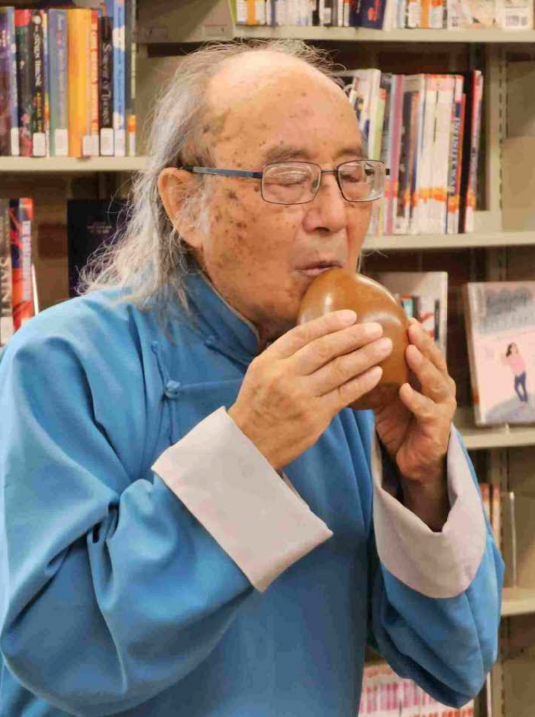
Composer and musician Ying Zhang demonstrates the xun, a traditional Chinese instrument.
Area readers visit China
Mon, 07/31/2023 - 1:51pm
“For the next 45 minutes or so, we are going to visit China,” declared Rhonda Lund, one of two presenters for “Dragons, Flutes & Monkeys,” a cultural and musical program shared at the New Richland library during the morning and the Waseca library in the afternoon on Thursday, July 11. Lund’s fellow presenter is Ying Zhang, 84, who received classical training on a variety of Chinese instruments and performed in a traditional Chinese orchestra before coming to the United States about 30 years ago. Now a composer and conductor, Zhang joins Lund for the cultural enrichment programs when their schedules allow.
The first half or so of their presentation featured Lund describing and telling the stories behind a variety of Chinese woodwind instruments. After each was introduced, Zhang, wearing a traditional Chinese robe used for formal occasions, would demonstrate how it was played and share a brief musical piece.
Made of clay, bamboo, brass and bamboo combined, gourd, and even bone, each was visually fascinating and offered an array of tones and moods.
The xun, a roughly egg-shaped instrument of a size to fill two cupped hands, has been played in China for about 9,000 years, according to Lund’s narrative. She told the audience that it is especially good at producing tones which are either scary or sad. The song excerpt Zhang played to demonstrate the Xun was inspired by an ancient story about a woman whose husband was conscripted to work on the construction of the Great Wall of China. When he did not return within the expected time frame she went looking for him, only to learn that he had been killed.
According to the story, the woman stood and cried with such deep emotion that the nearby section of the Great Wall felt sorry for her and collapsed. After that, whenever that section would be repaired, it would collapse again, all in sympathy for the woman’s grief.
When describing the gudi, Lund explained that its name literally means “bone flute.” She told audience members that the instrument has been used for thousands of years, and was carved from the bones of whatever large bird might be available. The gudi she showed during the presentation was roughly 8 inches long and had been personally made by Zhang, even beginning with collecting the bone from a Thanksgiving turkey, washing it thoroughly, and then setting it aside to cure.
“He tells me that, if you make four, probably three of them won’t turn out, won’t have a good sound,” she said. “But this one–this is one of his favorites because its tone is very good.” A second, much smaller bone flute provided an imitation of an elaborate bird call.
The hulusi is an instrument which uses a gourd, bamboo, and copper wires. Lund told audience members that its tone has elements in common with both the bagpipe and traditional instruments used in India by snake charmers.
The final demonstration was the lushung, an elaborate combination of bamboo, brass, and reeds. Given that it shares tones with a pipe organ, audience members were somewhat surprised whe Lund revealed that the instrument is often played while dancing. Zhang’s demonstration included walking and swaying.
The second major element of the presentation was a traditional Chinese story whose title Lund kept to herself until she had finished. She drew the audience in with elements of suspense and repetition; children joined in on certain lines they could anticipate. By the time she had finished the story of “The Boy Who Became a Dragon,” Lund was pleased with the level of engagement audience members, and especially children had shown.
“That’s precious,” she said. “It’s a delight to share a story and an experience with people who are willing to truly join you on the journey.”
The program closed with volunteers being invited to the front to make use of an array of percussion instruments. Lund directed as the volunteers followed her instructions; Zhang accompanied on a traditional bamboo flute.
The presentations in both New Richland and Waseca were offered by Community Programs in the Arts (COMPAS) through a grant provided by the Traverse des Sioux Library Cooperative thanks to a legislative appropriation from the Arts and Cultural Heritage fund. COMPAS (Community Programs in the Arts), a non-profit education organization that teaches through art, has been putting creativity into the hands of Minnesotans for almost 50 years.