
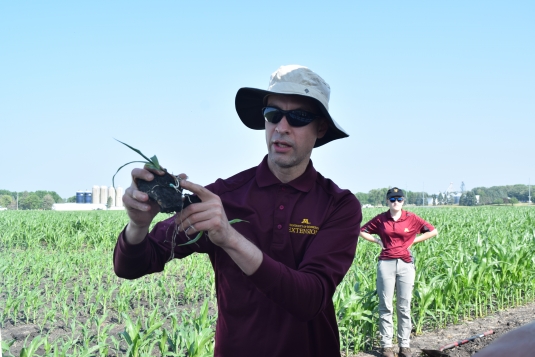
Jeff Coulter explains to agronomy tourists how to tell whether a corn crop is healthy by looking at its root system.
Digging deeply into agronomy
Fri, 07/14/2023 - 1:16pm
The world of agriculture has advanced throughout the years. It’s not as simple as plowing the field, planting the crop in the spring, checking to make sure the crop has enough water in the summer, and then harvesting it in the fall. These days, agronomists — those who study soil management and crop production — are getting closer to boiling the complex world of farming down to an exact science.
That’s why on Tuesday, June 20, the University of Minnesota Southern Research and Outreach Center of Waseca offered an agronomy tour to equip area farmers with tools to better understand how they can manage their crops to assure maximum yield. About 50 farmers from Mankato to the Austin area attended.
The day began at the outreach building at 8:30 a.m. with UM Extension nutrient management researcher Dan Kaiser giving a presentation on using products with naturally occurring organisms to enhance crop health and fertilizer uptake.
Kaiser explained that there are new products on the market made with these naturally occurring organisms for corn and soybean production. In his research on using the biological products on corn and soybean crops, there was an inconsistency with the results. “I found that if you used thirty pounds less of the products than is suggested, you see the best results,” he explained. “But even then, results can still be inconsistent.”
Some may be able to boost the crop’s overall health early but did not make much of a difference in the later stages of the crop’s life.
Kaiser also pointed out that Minnesota soils are already biologically active. “You have to decide whether or not the product you apply can survive and outdo what is already there,” he said. “IS the rate you are applying enough?”
He added that site selection is important, and that trying out biologicals is a “system approach.” “I would suggest using small plot trials.”
After his presentation, the farmers loaded up onto three separate units and went out into the field where there were four more presentations waiting for them.
Jeff Coulter, UM Extension Corn Agronomist, explained to farmers how they can monitor the overall health of their corn. He handed out smaller corn plants to give examples of a healthy root system.
For the best results, corn is usually planted at least 1.5 inches deep. This allows the corn to grow strong nodal roots, which are important for getting water and nutrients for the crop. Nodal roots may not develop well if the seed is planted shallow or if the weather does not cooperate.
Another way Coulter suggested checking the health of corn is by the amount of leaves. The count starts at the leaf closest to the ground that is fourteen inches. From there, each leaf represents a V stage. V5-V6 is when the growing point of the corn is above the soil surface.
Most corn crops at his station were close to V9 or V10, meaning that the corn will enter the reproductive phase. “There’s a great chance that they will have a pretty good yield,” he explained. “The smaller looking crops may not have as great of a yield.”
This is due to ponding of water from the winter snow which affected early growth of the crop.
Jeffrey Vetsch presented data concerning crops that provide winter soil coverage, something that’s been getting more attention from Minnesota farmers every year. Winter cover crops can provide protection of the soil while enriching it with nutrients plants need like nitrogen and phosphorus.
Vetsch explained, “Seeding a cover crop after corn silage harvest could scavenge nitrate, protect the soil from erosion and return some of the carbon lost during silage harvest.”
Research results were somewhat inconsistent. In the fall of 2021, there was excellent cover crop growth, with the cover crop blend producing a slightly lower carbon-to-nitrogen ratio than the rye cover. However, there was very poor germination in the fall of 2022 due to the ground being too dry. Rye did lower nitrate levels in the soil in the spring of 2022, while the blend and soil with no cover crops produced similar results.
Tom Hoverstad, an agronomy researcher for the Southern Research and Outreach Center, presented some research on products used for corn and soybean weed management. Melissa Wilson, a UM Extension Nature Nutrient Management Specialist, was also in the field giving a presentation on nutrient management in manure systems.
The program ended at around noon with everyone enjoying a lunch provided by the Southern Research and Outreach Center.
With all the information presented, local farmers can use some of it to produce some of the best yields of crops possible. However, as Hoverstad pointed out, what could be one of the driest Junes on record could present a challenge.
“We had a pretty dry month of May followed by the driest June in decades,” he told the farmers. “Thankfully, with the record amount of precipitation we got in the winter, it’s counteracting the dry spell right now.”