
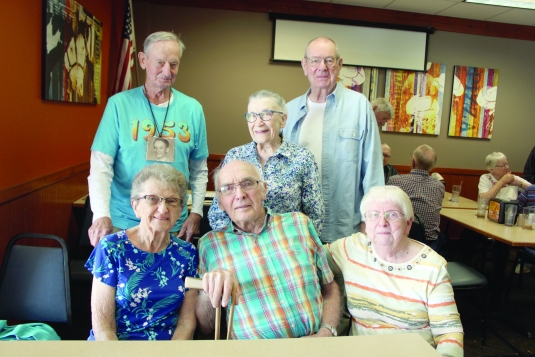
Members of the Waldorf High School Class of 1953. Front, from left: Wanita (Gilster) Groskreutz, Duane Hutchens, and Barbara (Bleess) Vogelsang. Back: Duane Hutchens, Joan Bluhm and Irvin Prail, Jr.
Back together
Waldorf class of 1953 reunion
Waldorf class of 1953 reunion
Fri, 07/14/2023 - 12:44pm
“I think the teacher pretty much gave up on them after that.”
— Joan Bluhm, Waldorf class of 1953
The room is packed, only a few scattered seats are empty. Seating has been designated by class, so choosing a chair feels like an intrusion. About a hundred conversations are going on simultaneously, and everyone seems to be raising their voices in order to be heard.
It’s not a school cafeteria, but it seems as if it might as well be–except for the white hair.
Graduates of Waldorf High School, a system which ceased to exist in 1960, are meeting for an “all-school” reunion, of sorts. Roughly 50 people, all in their 80s or older, chat energetically about everything from old times to hot gossip.
At the “Class of 1953” table, it is revealed that six of the original 18 class members are present. Neither number seems impressive until some of the details are revealed.
Duane Hutchens has come from Kentucky. Irvin Prail is in from Las Vegas. Joan Bluhm has
driven down from the Cities.
Maybe because they were such a small class–other “years” at the gathering mention graduate numbers in the mid- and high twenties–maybe simply because of compatible personalities, member Wanita (Gilster) Groskreutz observes, “We were more like brothers and sisters than classmates.”
In keeping with that, the Class of 1953 began holding class reunions five years after graduating, and has met fairly regularly every five or 10 years for the seven intervening decades. The “all-school” reunions which have been taking place the last 15 years or so, are an outgrowth of the group’s planning. Memories and stories fly so thickly it’s hard to keep track of who’s speaking.
Across the table, Joan Bluhm’s shoulders are tense and her facial expression is one of terror. She is telling about the wayward boys in her science class who disconnected a bunsen burner and touched flame to the hose. “They sent fire shooting all around,” she remembers. In a confidential tone, she adds. “I think the teacher pretty much gave up on them after that.” To separate herself from that behavior, she spent much of her time in class using the “social media” of her day.
“I had 30 pen pals,” she admits. “I just pretty much used the class to write to them.”
Pen pals, it turns out, were both common and popular. Groskreutz mentions a publication called “A Child’s Home Companion.” The back pages had the birth dates and addresses of children from all around the country; interested writers were encouraged to choose someone who shared the same birthday.
“I had the same pen pal from the time I was 8 years old,” remembers Groskreutz. The two remained in touch well, literally for life, exchanging letters as they married, had children, and developed the many facets that work together to make life interesting.
Asked about the most technologically advanced equipment they worked with in high school, members of the group give varying answers.
Hutchens, who ended up spending 1955 and 1956 in Germany on Uncle Sam’s ticket, became his company’s clerk because he had learned to type in the Waldorf High School’s business education department. Typewriters were something none of the class members had at home. As for the craft of typing, Hutchens had been enrolled in the class somewhat unwillingly. He remembers being the only male–according to his female classmates, it was expected that they would take it, but a boy in the class was a novelty.
But as for the class he didn’t want to take–he remembers thinking it would be no use to him–it made him, the only company member who could type, the company clerk. Then he used it again when he got a job with North Central Airlines as one of the trainers for ground personnel in Chicago. As for that job, well, it helped him find his wife, who showed the country boy “the ways of the big city.”
Still, despite the many advantages his skill as a typist provided him, Hutchens believes the most important thing he learned by attending Waldorf schools was, “small-town values; friendship, churches, and neighbors helping neighbors.”
Irvin Prail also remembers taking a class he did not sign up for, “economic geography.” He can’t summarize what the course taught him, but he can explain how he ended up in it: “Ted and I were known troublemakers,” he admits. “So I couldn’t be in the same physics class as he was.”
In addition to the bunsen burner incident–concerning which she names no names–Bluhm also remembers a group of boys who would work together to pick up a set of desks, then move forward like a train shouting “Choo! Choo!” The teacher's reaction was to chide “Boys! Boys!” At least by the end of the year, however, his scolding had no effect.
“Somewhere in there,” Bluhm says, “he just gave up.”
Groskreutz and classmate Barbara Bleess Vogelsang remember being impressed by the electric sewing machines in the (then) newly finished home economics department. “We didn’t have anything like that at home,” remembers Groskreutz, who had learned to sew on a treadle machine.
Vogelsang recalls being expected to take home economics, but wondering why. By her early teens, every girl in the class was already an experienced cook, seamstress, and housekeeper. Something no member of the class ever did figure out, though, was the “mangle iron,” a large device with rollers and a lever meant to press linen and clothing flat using weight, rather than heat. “I used it once, for a bed sheet,” remembers Groskreutz. “But that’s all the good I ever got out of it.”
A tremendous scandal in the community during the Class of ‘53’s tenure was that one of their teachers was…pregnant. “Back then,” observes Vogelsang, “if you were pregnant, you did not sit at the front of a classroom.” This particular teacher had been hired in spring and did not report to the school until fall. As her “secret” became apparent, the district had few options to replace her, and so she stayed..despite the “scandal.”
Vogelsang, Groskreutz and Bluhm also remember when the teacher’s sister came to fill in for her. “She spent a lot of time talking about china, crystal and silver,” remembers Bluhm.
“My parents thought it was ridiculous,” declares Groskreutz. “None of us were ever going to be rich enough to afford those things!”
Another advance that occurred in the school system during the Class of ‘53’s tenure was school lunches. Until 1952 or so, students had no choice but to bring food from home. Thanks to new construction–and possibly new funding–hot lunches became available in the last year or two of the class’s stay.
Members of the Class of 1953 enjoy the opportunity to recall those times, always said to be simpler, but perhaps not. Their shared history gives them roots that they like to connect with, and reminds them of the community and school system which nurtured those roots.
“Growing up in Waldorf was marvelous,” raves Bluhm. She recalls a time roughly 83 years ago when she reported to first grade in the school’s system. “I was the last one to arrive,” she says. “The teacher looked at me, put her hands over her eyes, and said ‘Oh no, not another one.’
“I was the fortieth student to arrive in her classroom that day. That was Miss Brewer; I’ll never forget her. She taught first and second grade–there was no kindergarten back then–and even though there were 40 students in that room, every one of us felt cared for. She was amazing.”