
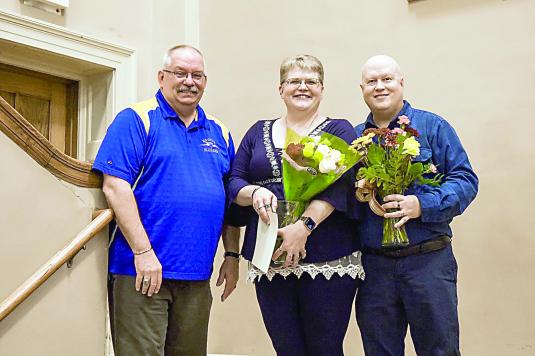
Skinner named teacher of the year
Sat, 12/31/2022 - 3:54pm
Dawn Skinner, Language Arts Instructor at the Waseca Area Learning Center, was named the Waseca Public Schools Teacher of the Year by the Waseca Education Association on Monday, November 18. Each year, teachers are nominated for this award by their peers. Nominees then complete an application detailing their experience and teaching philosophy, which goes to the award committee for review and selection. The award was presented to Skinner on behalf of the WEA by Craig Brenden, co-president.
Skinner grew up in the town of Mahtomedi, northeast of the Twin Cities, where she graduated from high school in 1990. From there she first attended St. Benedict’s College followed by the University of Minnesota Twin Cities, where she received a Master’s in English Education in 1999. In 1996 she married Mike Skinner, who is currently a math teacher in the Janesville-Waldorf-Pemberton district. They have two children ages 21 and 18. Before coming to Waseca Public Schools, Skinner taught in Forest Lake, North Branch, and Waterville. She has been a teacher in Waseca since 2002, teaching first at Waseca High School and transferring to the Waseca ALC in 2009. She came to Waseca from Waterville after being offered what she described as “literally my dream job,” teaching English and Theater.
Since she was in eighth grade, Skinner knew she wanted to be a teacher. Her plan at the time was to go to college to be a music and theater teacher, to which she says her father responded, “No, you’re not. You have to teach something that will pay the bills.” English was the obvious next thought for Skinner. “I had a really important English teacher when I was in high school, and she is the reason I am an English teacher.” Ms. Lambert was her name, and Skinner now counts her among her best friends.
After more than 20 years in the profession, she says she stays for the kids. “I love my kids. I teach what people would call the hardest kids, and for me they are incredible. They think such deep thoughts and they trust me, so we do curriculum here that is college level because they trust me to get them there.”
While being a parent and a teacher is enough to keep anyone busy, Skinner also serves as Treasurer and Membership Coordinator of the Minnesota Thespians, the state branch of the Educational Theater Association; she also co-founded a Gay-Straight Alliance at the Waseca ALC. She applied for and received the Classroom Focused Grant this year, a $3,000 grant from the Education Minnesota Foundation for Excellence in Teaching and Learning which is being used to support her Theatre for Social Justice course. This innovative ALC class encourages students to use the arts to grapple with the big issues that affect them as teens. The class culminates in a play – the fourth play put on by Skinner’s ALC students is scheduled for January and addresses teen suicide. Next year, Skinner plans to cooperate with another instructor at the Waseca ALC to expand the class into the visual arts curriculum as well, and already hopes to see that effort supported by the same grant.
Continuing education, community service, and outstanding accomplishments are all factors in the selection of Teacher of the Year, but a large portion of the process also rests on applicants’ educational philosophy – their core beliefs regarding teaching and learning – and how they put it into practice in their classrooms. In short, Skinner describes her philosophy as “Relationships before Rigor,” which she says is commonly discussed in educational spheres but less commonly implemented. In the Waseca ALC, Skinner teaches primarily students who have struggled and often failed in traditional classrooms, whether due to social or curricular factors. “We concentrate on making sure kids are safe, heard, and appreciated before we expect them to do a lot of big projects. It’s all about making relationships.”
By meeting her students where they are and connecting with them, Skinner is able to teach more effectively. She says that once she’s established those relationships, her focus is on allowing students to take agency over their learning, encouraging self-evaluation, and teaching skills for life outside of school. In addition to her English and Theatre curricula, Skinner teaches her students executive function strategies, skills for emotional regulation, goal-setting, and self-advocacy. As she wrote in her application to the Teacher of the Year committee, “The educational philosophy I have described is one that moves students from teacher-directed learning to self-directed learning and prepares them for success in the real world. As a high school teacher, I can think of no greater goal than to foster individuals who can be active participants in their own lives, their communities, and their world. Not one of my students will remember the language arts lessons I taught them, but they will certainly remember the successes they achieved in my classroom, and the way I treated them as people. There is no higher honor than to have former students who are still ‘my kids’ after all these years.”
Skinner expands her curriculum broadly to best serve students at the Waseca ALC, but she is still an English Language Arts teacher, and her philosophy of relationship-building and applicability to the real world extends into that curriculum as well. During the next “hexmester,” as the Waseca ALC follows a six-part school year, she’ll be teaching a class which she calls “I Hate English.” It is, officially, Remedial Language and Literature, but Skinner says that the traditional approach to remedial classes can be boring and demoralizing, and it isn’t what her students need. During the class, she talks with her students about alternate methods of accessing information. Two such methods are graphic novels and audiobooks. She talks with them about the benefits and downsides of these methods – and why watching the movie is not a good strategy – and helps her students to choose the method that best fits their needs and goals. Many of her fellow English teachers balk at the idea of not only allowing but encouraging students not to read the full, traditional versions of the assigned books. “It’s another way to get reluctant readers access to materials,” Skinner says of the practice. To her, it’s what makes sense. “That’s what I do here; I find ways to make education accessible to kids who have grown to dislike education.”
The Teacher of the Year award is an honor, and Skinner has received and accepted plentiful acknowledgments and congratulations. Her colleagues and her former students agree that she is deserving of the award and its accompanying praise. Skinner hasn’t said that she disagrees, but did add, “The Teacher of the Year recognizes one person in a district where everyone goes above and beyond. The recognition of my peers is wonderful, but there are many teachers who deserve this recognition who work for Waseca. We have an incredible district.”