
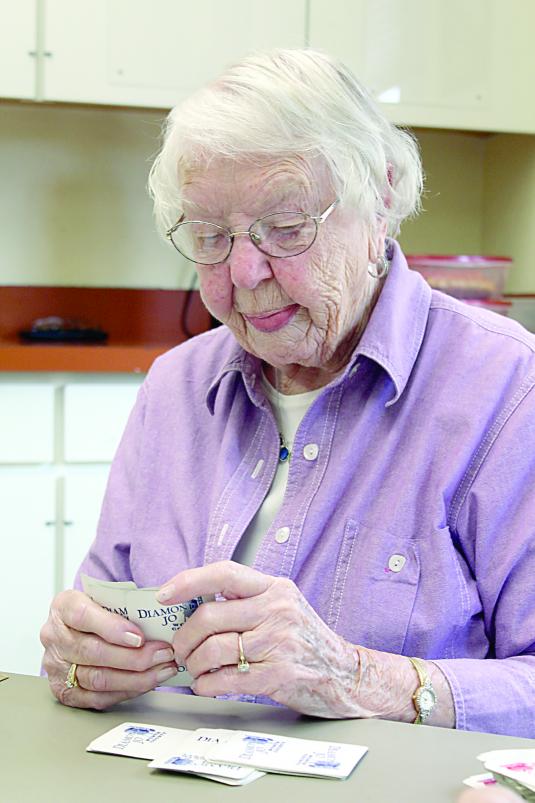
Helen Fowler plays Bridge during the weekly tournament at the Waseca Senior Citizens’ Center.
Fowler thriving at 102
Waseca’s Helen Fowler celebrates birthday
Waseca’s Helen Fowler celebrates birthday
Thu, 12/29/2022 - 9:10pm
“I don’t feel old. Time just rolls along, and I roll with it.”
— 102-year old Waseca resident Helen Fowler
Though she has been driving–legally–since the age of 12, Helen Fowler has never taken a driver’s test. “Well, back then,” she explains, “you just went to town and paid, and they gave you a license.” The cost, “back then” in 1932, was 25 cents.
Fowler, who turns 102 today, grew up on the Gallagher family farm located about 5 miles west of Waseca. At 12, she only drove the car to the fields to deliver lunch to the workers. “And the cars didn’t move very fast,” she admits.
She’s driven a lot further since then, during a life which has moved very fast indeed.
“I don’t feel old,” she declares. “Time just rolls along, and I roll with it.” Fowler still lives in a Waseca residence where she’s lived the past 29 years. She manages her own affairs and prefers getting news and information on her iPad rather than by watching television. She loves to read, devouring a book every five to seven days. A member of the Lakeside Golf Club since the 1940s, she stopped golfing when she was 99–but still meets friends almost every week for a “Ladies’ Night” meal. To commemorate her 101st birthday, the golf club began waiving the usual annual membership fee indefinitely.
Though her 1994 Buick can be classified as an “antique,” she prefers it over newer cars with their many electronic features. “I wouldn’t know how to drive something with all those fancy things,” she says lightheartedly. “This car is a good one for me, and I expect to keep it until I don’t need a car anymore.” She laughs about the surprise her great-grandchildren express when they discover “Grandma’s car windows have cranks!”
She observes that the car gets relatively light use these days. “I only drive in town,” she says. “And I don’t drive after dark.” Still, the vehicle does more than sit in the garage: shopping, Bridge tournaments and Bingo at the Waseca Senior Citizens’ Center, an occasional drive around the lake–”just to see who’s out golfing”--and other social gatherings.
But then, society is something Fowler has craved since childhood.
Growing up on the farm, her life was kept in a very small frame. One of five children, she began helping with daily chores from the moment she was old enough to manage them. “I never really learned to be a good cook, though,” she observes. “My mother wanted to do all that on her own, and she didn’t want any help, so she gave me other jobs.”
She and her four siblings attended a one-room schoolhouse located directly across the road. In fact, it was so closely associated with their property that it was called the “Gallagher School.” The teacher, to the children’s chagrin, roomed in their 6-bedroom home.
“We always felt like she was paying a lot of attention to whether we were doing our homework,” recalls Fowler. In exchange for the room and board, Fowler says her mother received $20 a month from the school district.
Also known as “District 16,” the Gallagher School is now located at Farmamerica.
The one-room school “graduated” its students at eighth grade, although Fowler attended only for six years because she was able to skip two grades. Asked whether she was a particularly intelligent child she suggests that it was really a matter of being able to hear everyone else’s lessons in addition to her own.
As she and her siblings–Fowler was the middle child–completed their learning at District 16, they transferred to Sacred Heart School in Waseca. There were no buses, so they all rode together in a family car. Fowler, especially, enjoyed the chance to widen her social circle and begin taking part in more activities.
After graduating in 1937 at age 16, she began attending what was then known as Mankato Commercial College to study business–that is, to learn typing, bookkeeping and shorthand: she was a woman, and it was the 1930s.
Here, too, whether she’ll admit she was a particularly clever student or not, she seems to have thrived. She had finished only one year of the two-year program when she was able to get a job with what was then called State Farmers’ Mutual. She became secretary to the company president, Ernest Rutledge. In the absence of any sort of recording devices, and with very limited ways of reproducing documents and information, her shorthand and typing skills were invaluable to the company.
Her dreams of a wider social circle were also being realized: there was roller skating at a rink near Loon Lake. There were weekly Monday-night dances at city hall.
And then, just as Fowler's career was getting a good start, the United States entered World War II. While her professional plans blossomed, her social life withered.
She remembers the irritations of rationing, having to have “stamps” to be able to buy tires, sugar, and nylons. Since all their boyfriends–current or prospective–were away, Fowler and a group of friends began playing golf: thus her decades-long membership at Lakeside.
The war also interfered in her career. “Wages were frozen,” she explains. “The only way to get a raise was to get a promotion.” Already central to the bookkeeping and record keeping at Farmers’ Mutual, Fowlers’ promotion came in the form of an important new task.
“After a storm, there would be a giant stack of checks to be signed, and the president didn’t want to have to sign them all. So I was promoted to ‘Authorized Signing Official.’
“But I had to sign the checks using my initials, so no one would know it was a woman’s signature.”
Her wages in the 1940s were $25 a month. “And there was no overtime,” she recalls. “When there would be a storm or a fire or something like that, I would put in 50, sometimes 60 hours a week processing all the claims. There was no extra pay for that.”
Still, as an aspiring professional she did quite well for herself, purchasing her first car in 1943. Although she doesn’t remember what she paid, an internet source claims that a new car cost about $800 at the time, and that gas sold for 18 cents a gallon. Fowler remembers she got a bargain, however, because she made the purchase alongside some new cars being acquired by the company. In fact, it having been war time, she might not have been able to buy a car at the time had it not been added to the company order.
When asked about a technological advance that changed her life, Fowler mentions the mimeograph. What many may think of as a mimeograph–a sort of reverse original which used strong-smelling chemicals to release blue ink onto paper–is, again according to internet sources, actually called a “ditto machine.”
The mimeograph machine is older technology: It required that ink be loaded into a large cylinder and then allowed to bleed outward through a stencil. It changed schools and offices greatly since, for the first time, it was possible for someone without a printing press to make as many as 3,000 identical copies of a single original. Prior to its availability, copies of a document had to be created individually–a very time-consuming process which often allowed for errors or inconsistencies.
Fowler first discovered the mimeograph in the 1970s. She remembers sometimes coming away from tasks as an inky mess, but it was still better than typing all the copies one by one.
She married in 1948, remaining with husband Harry for 42 years. They operated Fowler’s Dairy from 1954 to 1978, with Helen’s business skills, including bookkeeping and communications, as vital assets. The company was located near the modern Armstrong building: it purchased milk from Marigold Dairy near Rochester and delivered it via three different routes to back doorsteps all over Waseca. Early on in the business, glass bottles were used and had to be collected and returned for sanitizing. Later, disposable paper containers were used.
After selling the dairy business in 1978, Fowler became a member of the Brown Electric staff. Her skills benefitted the long-standing downtown television and appliance company from 1978 to 1994, when she retired at age 74.
Fowler remembers the 56 years which spanned her career as a busy time. She misses certain things which have changed, recalling that downtown Waseca once had five grocery stores and four dress shops, all within a few blocks of each other.
She and Harry raised four children: Mark, Mike, Connie, and Brad. Of the four, two are still living; daughter Connie lives in Virginia. The youngest, Brad, in his early 60s, is considering retiring from his career as a crop duster in North Dakota.
Fowler admits she has no genuine answer for all the people who ask for the secret to her longevity. “Just keep moving and keep breathing, I guess,” she says with a smile. She can make no claim to any special knowledge or technique, admitting she owes a great deal to genetics: her mother, Mary Marso Gallagher, died in 1994 at age 100.
In her case, she says, reaching this week’s 102-year milestone, is something of a perfect storm: “Good genes, good friends, good health–and a lot of good luck.”

