
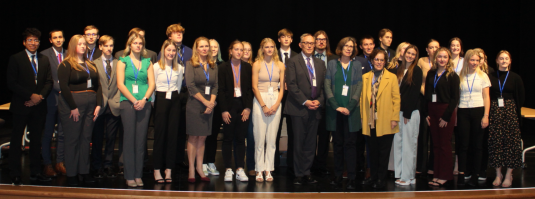
Students and judges who took part in a Minnesota State Court of Appeals session at Waseca High School November 21.
A whole new angle to justice
State Court of Appeals holds session at Waseca High School
State Court of Appeals holds session at Waseca High School
Tue, 01/02/2024 - 3:59pm
“It was truly impressive how much
respect the students showed for the proceedings.” — Teacher John Hanson
Members of Waseca High School’s American Government class were able to see their subject from a whole new angle on Nov. 21.
The State of Minnesota Court of Appeals held a session on the school’s performing arts center stage. The session began just before 10 a.m. and, with the question and answer session which followed, lasted about an hour.
Planning for the session had been underway for months; Waseca High School graduate Renee Worke, who is now one of the 19 judges on the state court of appeals and who served as Waseca District Court judge for more than a decade, assisted in coordinating the event, as did high school social studies teacher John Hanson. All high school students–roughly 300–attended.
As the session was about to begin, Worke described the procedures and expectations usually followed at appellate proceedings. Unlike the court trials many may regard as “typical,” no witnesses are called during an appeal.
An appeal, she explained, happens when either the prosecution or defense in a trial feel that some circumstance led to someone’s constitutional rights being violated–in essence, that the trial was not fair in some way.
The appellate court gives a panel of three judges the task of hearing the two sides of the case and deciding whether the expectations of a fair and speedy trial were met. Judges are provided with full transcripts of court proceedings for reference, and are expected to acquaint themselves with the circumstances of the hearing in advance.
Worke told the assembled group that the appellate court usually meets in the Minnesota Judicial Center in St. Paul, but occasionally meets elsewhere for the sake of outreach or to reduce litigation costs. Such was the case with last week’s session.
Students in Hanson’s government classes had spent a few class days familiarizing themselves with the circumstances of the case.
The “appellant,” that is, the party requesting the appeal, is Olmsted County resident Elvis Porte who was placed on trial earlier this year and convicted of possessing an illegal substance and of fleeing a police officer on foot.
On the night he was arrested, Porte and three others were in his vehicle, which an Officer Crabtree had stopped for having overly dark tinted windows. During the stop, Crabtree had asked for and been granted permission to search Porte’s vehicle. While the four occupants stood off to the side supervised by additional officers, Crabtree began his search. He noticed an unusual looking can with a twist-off lid. When he removed the lid and looked inside, he reported seeing a leafy substance divided into small plastic bags.
Crabtree set the can on the roof of the car and was about to continue his search when Porte suddenly dashed to the vehicle, grabbed the can, and ran down the street, tossing the can into a yard along the way.
Officers apprehended Porte and recovered the can. Porte was placed on trial and convicted. The audience in the performing arts center was told Porte could otherwise have been present at the proceedings, but because he is currently incarcerated, was watching via live streaming.
Following typical court of appeal proceedings, Porte’s lawyer, Roy Sperbeck, was given 15 minutes to address what he perceived as the violation of Porte’s rights.
During Sperbeck’s presentation, the audience learned Porte had accepted the services of a public defender after being arrested. The trial had begun and the police officers who were present the night of Porte’s arrest were questioned.
Shortly after all police officers were excused from the court, Porte announced that he was “firing” his attorney and intended to take up his own defense. Porte then requested that Officer Crabtree, who had already been examined and cross-examined, be called back to the witness stand.
The judge in the case pointed out that Crabtree had let the court know in advance that he would be leaving on vacation, and, after a brief exchange with others in the court, the judge declared he was not going to “go backward” with the proceedings.
Lawyer Sperbeck made the case that, even if it had meant a delay in continuing the court proceedings, Porte should have been given the right to recall Crabtree to the witness stand. Sperbeck claimed Crabtree had apparently contradicted himself during his testimony, at one point stating he did not process and weigh the evidence on the evening of the arrest, and at another point seeming to claim he had. Sperbeck suggested Porte had “fired” his public defender because he had not called attention to this contradiction. He further suggested that, if Crabtree had been established as an unreliable witness, the jury might not have convicted Porte.
Assistant Olmsted County Attorney Jim Haas was given 15 minutes to present the county’s side of the appeal. Haas stated that Porte had no one but himself to blame for the outcome of the trial, suggesting that his sudden decision to “fire” his lawyer left him with no understanding of proper court procedures. Haas made reference to some of Crabtree’s statements in the transcript and claimed none of them would “impugn his authority” as a witness.
When both lawyers had completed their statements, the court of appeals adjourned.
The three judges, who had been dressed in robes throughout the proceedings, left the stage and returned dressed in street clothes. They and Worke accepted questions from the crowd, with the understanding that the judges would not be discussing the case they had just heard.
Questions from students regarded what steps students should follow if they wish to pursue a career in law, what it was like to transition from being an attorney to being a judge, and even how the judges managed to stay interested even when the topic being discussed might seem uninteresting.
Five members of Hanson’s government class, Jacob Thompson, Ava Omtvedt, Grace Below, Evelyn O’Brien and Ella Krautkremer, shared their thoughts regarding the appellate proceedings in a later discussion.
All five complemented defending attorney Sperbeck for the quality of his arguments.
“He did a good job,” said Jacob Thompson. “After what he said, I felt more like the defendant deserved another chance.”
Ava Omtvedt made a similar observation, saying that, although her opinion had been against Porte after studying the case, she now felt he “might as well get another trial.”
Grace Below concurred, saying the appellate proceedings seemed thorough and fair. She also expressed gratitude for the judges’ willingness to answer questions from the audience.
Ella Krautkremer said the proceedings had led her to a complete change of opinion, from “not a chance” to “he definitely deserves a retrial.”
Evelyn O’Brien, who was among the eight students who acted as escorts and assistants to the judges, said it was a privilege to take part. She commented that being the first high school to host a session of the Court of Appeals helps show that Waseca is a progressive school which finds new ways of accomplishing things.
All five students said they were grateful for the opportunity the day’s proceedings had presented, and said they look forward to seeing what other programs they can take part in.
Teacher John Hanson also expressed his gratitude for the opportunities the day brought his students. “It also has to be said how well the students behaved,” said Hanson. “It was truly impressive how much respect they showed for the proceedings.