
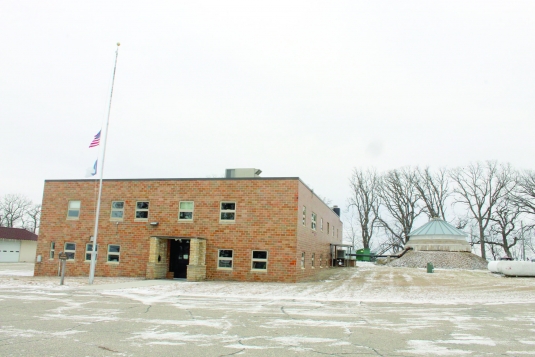
Under plans for expansion and improvement, the Waterville Fish Hatchery's original block structure will remain and be remodeled. Another building will be added to the grounds.
Waterville fish hatchery due for significant upgrades, expansion, in 2026
Thu, 02/06/2025 - 11:43pm
Though the project is working its way through some extensive planning stages, excitement runs high at the Waterville State Fish Hatchery for some long-awaited upgrades due to enter the construction phase in the spring of 2026.
Waterville Area Fisheries Office and State Fish Hatchery Supervisor Craig Soupir points out the 120-acre facility located along Lake Tetonka was constructed in the 1950s and, more importantly, with very different work in mind than it has come to be used for.
According to Soupir, the 10 members of the office and hatchery staff take on the task of managing about 120 lakes as well as many rivers located in Blue Earth, Dodge, Faribault, Freeborn, LeSueur, Mower, Rice, Steele and Waseca counties. This includes monitoring water quality elements which affect fish and–most important to area anglers–adjusting fish populations in a number of ways, most notably by stocking popular game fish.
He goes on to note that, in the 1950s, conservationists believed removing common carp was the best way to improve water quality and encourage increases in desirable fish populations. Thus, crews of DNR workers based out of the Waterville facility would travel to area bodies of water, net carp, and bring them back for short-term storage in a long, low structure which still stands on the modern site. Soupir says that, to the best of his knowledge, the fish were given away to interested residents and sometimes shipped away in large quantities, often in wooden crates. The workers bunked on site; there was even a staff cook who ensured they received meals. Noting that many spaces in the hatchery building have been repurposed, he comments, “We’ve come a long way since those days.”
Thanks to that evolution, the indoor and outdoor spaces at the hatchery have continued to be adjusted as the modern focus on collecting fish eggs and hatching them under controlled conditions evolved.
“Our staff, past and present, has really done an amazing job of finding ways to modify this hatchery space and get the job done,” observes Soupir. “Still, the limitations of the 1950s construction make our work much more complicated than it needs to be and make certain tasks simply impossible.”
Those limits, he says, create concerns when it comes to “biosecurity,” water temperature control, water quality and staff safety.
Water used in tanks inside the building is pumped from a well into a 10-acre drainable pond converted to a storage reservoir. Water for the 53 acres of drainable outdoor ponds comes directly from Lake Tetonka. There is no option in the aging plumbing system to install any type of filtration, so impurities and biological elements such as small plant matter, seeds, eggs from any type of water dweller, and even small fish cannot be removed from water brought in to support the development of eggs and mosquito-sized hatchlings, known as “fry.”
The fact that spaces and equipment are used for so many different tasks also causes concern about whether contaminants could migrate within the facility. Staff takes all possible precautions when it comes to biosecurity, Soupir points out, but wishes it were feasible to incorporate more.
There is also no production-scale system to manipulate water temperature. If there were, Soupir suggests, the work done there now would be more efficient, and the facility would be able to expand to raising not only more fish, but more types of fish. At this time, he says, the facility hatches the majority of the walleye stocked in lakes statewide. He shares that it’s been discovered a genetically distinct strain of the fish lives naturally in the Cannon River watershed system; particularly resilient and with many desirable qualities, walleye from the strain are now stocked throughout southern Minnesota and in the Lower Mississippi River watershed that extends below St. Anthony Falls in St Paul.
Northern pike and muskies are also hatched and raised to various stages of growth, then released in lakes scattered all over the state. In some cases, the stocked fish are already up to 17 inches long.
That information leads Soupir to yet another shortcoming of the hatchery’s current facilities. The outdoor ponds which range in size from one to ten acres have aging water control and drain structures. The 10 smallest, the one-acre excavations, weren’t even built for rearing fish for production, but were created for hatchery research. Because they cannot be drained into some sort of central catch basin, workers must lower the water level and, as they do, wade in the pond carrying buckets to grab those “fall fingerlings” by hand, then deliver them to shore one bucketful at a time. Soupir points out the facility raises roughly 10,000 Muskie in ponds to the 11-inch length each year.
With a better-designed facility with temperature controls, Soupir thinks enthusiastically of a day when various fish species will be raised to desirable sizes all year around.
A space designed for all those processes would not only be more productive, diversified and efficient, he enthuses, but also much safer for fishery staff. Based on elements of the update plan currently being refined, he says he expects at least 1.5 times more fish production than is being accomplished now: Soupir names increased output as a primary goal of the improvements. He says he also looks forward to how responsive the facility can become, potentially using the updated equipment and spaces in new ways as new challenges arise.
Also, since there is considerable public interest in the hatchery and its work, he says he looks forward to a more accommodating space which allows visitors to see the processes in use and better understand what’s being accomplished.