
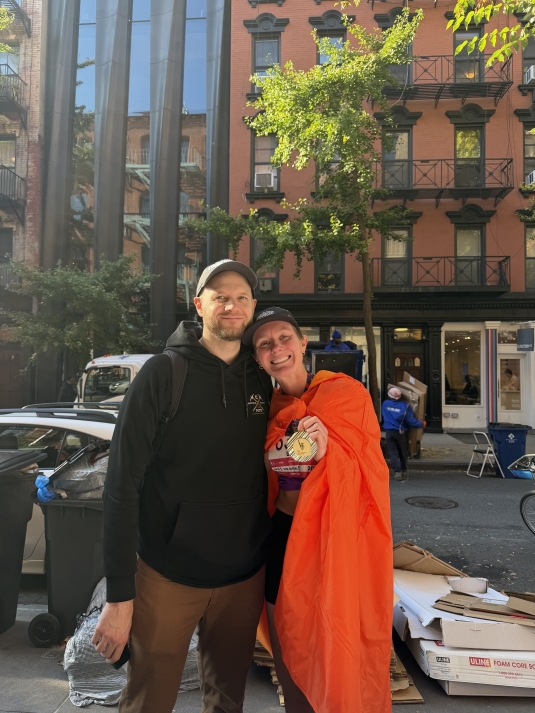
FINISHER - Briee Mercier with her boyfriend Steve after she finished the New York marathon on Sunday, Nov. 2. Her time was 2 hours 50 minutes and 7 seconds.
Wasecan completes 'strong' run in New York marathon
Thu, 11/20/2025 - 2:15am
More than 60,000 people took part in the New York City marathon on Nov. 2 this year; well over 59,000 of them finished the course–a world record. The average finish time was 4 hours 32 minutes.
Wasecan Briee Mercier, 33, finished in 2 hours 50 minutes 7 seconds. “I could tell I was running a strong race,” she says of the experience. “At the end, I was passing more people than were passing me, and just generally I didn’t feel myself slowing down as the miles went by.”
Among more than 27,000 women who completed the course, Mercier was ranked 53.
A 2010 Waseca graduate, Mercier says running started out as a means to an end for her–she was on the school tennis team all four years of high school and used running as a way to be fit for the game. She also participated in track and basketball.
In college at the University of Minnesota, she signed up for a class designed to help runners train for marathons. Course instructor Chris Lundstrom had a career as a professional marathon runner and has most recently coached one of the women on the Olympic marathon team. Between Lundstrom’s motivational style and the course’s final requirement of actually finishing a 26.2-mile marathon, Mercier says she “got hooked on racing.”
She ran her first marathon in Eau Claire, Wisconsin, in 2012 to meet the final requirement for the college course. Since then, she has gone on to run 14 marathons across 13 years, including Grandma’s in Duluth, the Twin Cities marathon, and others. The two most widely known were the Boston marathon in 2024 and this year’s run in New York.
A physical therapist and PhD candidate in rehabilitation science, Mercier says she trains daily, usually running on the trail around Clear Lake and on nearby roads with her Brittany spaniel Waffle as a companion. The two of them log between 65 and 85 miles of running each week.
“I’m nobody special,” says Mercier of her many runs. “Just someone who found a passion in running and has been consistent and dedicated to it over a number of years.
“It’s been a big benefit to me to put in the work and see the fruits of those labors.”
She observes that early in her training “I couldn’t have run a mile at the pace I averaged throughout the whole marathon in New York.”
She credits some of her success to a number of factors that aligned on Nov. 2.
Although there are hills in the New York course, which winds through all five of the city’s boroughs and crosses numerous bridges, she describes a “rolling” effect: That is, after laboring up one side of each hill came the benefit of running down the other side.
While that may seem like a given, she mentions that the course in Boston finishes with a long uphill push, made to seem longer because it comes after runners have already come about 25 miles
The temperature in New York was in the low 50s on Nov. 2, and winds were calm–essentially ideal weather.
Also a benefit, she continues, was the enthusiastic support from the gigantic crowd which lined nearly the entire course. “They were cheering us on, shouting out encouragement, wanting to give high fives,” remembers Mercier. “That energy really helped.”
Along with the crowd in general, Mercier could also set her sights on certain locations along the course where she knew friends or family were watching for her, and where she knew her boyfriend Steve would be ready to cheer for her. Along with that was the ever-changing view–the buildings, parks and structures along the course.
“Having a string of things to look forward to is a great motivator,” she comments.
Though it may not seem like it with 60,000 runners, not everyone who wishes to take part is granted a space on the starting line, Mercier describes. The marathon is organized by the New York Road Runners Association. Applicants who have officially logged strong times in other marathon events are placed in one lottery and have a somewhat higher chance of being selected, but not everyone with qualifying times gets in. Mercier would know. She says she applied for the 2024 New York marathon and was not accepted. Applicants without qualifying times are also placed in a lottery.
According to the marathon’s website, more than 200,000 people applied to be part of the 2025 marathon; of those, not even 5 percent were accepted. A “guaranteed” way of getting a slot is by being part of a team raising money for an acknowledged charity. But even the “charity” runners must pay the $250 entry fee.
The next goal Mercier has set for herself is achieving a time of 2 hours 37 minutes or
less, the threshold for being allowed to compete for a spot on the U.S. women’s Olympic Marathon Trials. The next international olympic games will be in Los Angeles in 2028, with the trials coming sometime in the spring of that year, so Mercier says she has more than two years to keep improving.
”I wouldn’t be competing to try and make the Olympic team: Making it to the trials would be the win for me. Competing next to all the other women on that day would be the celebration of all the hard work and reaching a difficult, improbable goal.”
The current record for the olympic women’s marathon is 2 hours 22 minutes 55
seconds, set in 2024.
As for how the challenges of training for marathons apply to everyday life, she says the determination and consistency of recovering from an injury is a much like building the stamina and motivation needed to complete a long run.
“Some of my patients know they have a long road ahead of them,” she observes. “With neurologic damage or with pain, it’s a long, difficult road during rehab.
“Each time they reach a milestone, we celebrate their hard work and their accomplishment.
“Then we have to find the next goal and work toward it.”