
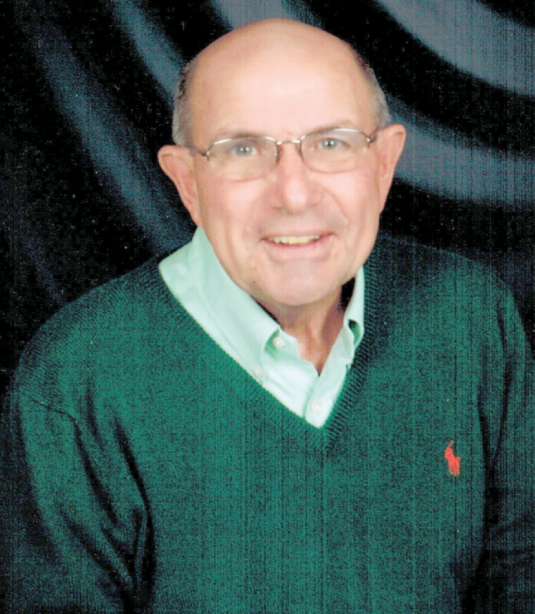
Ronald Eustice
Training as Ag specialist, communicator, leads to 20 books in retirement
Sat, 03/23/2024 - 1:09pm
By RACHAEL JAEGER
Staff Writer
Ron Eustice, a Waseca area resident in his youth, has written twenty books based on his experience in agriculture and his work with Minnesota farmers. Currently, he’s also working on an autobiography with the working title, “Around the World in Eighty Years” which he anticipates he will publish within a year on Amazon.
While he has written his books only since retiring in 2012, his first writing efforts began in grade school and high school. When he was a journalism student at the University of Minnesota in the 1960s, Eustice wrote feature articles for national and regional cattle magazines.
He says those early opportunities helped him acquire experience and confidence in publishing, allowing him to continue as a writer throughout his career. Once out of the university, he began working for the Carnation company in the early 1970s. Sent to help producers in Mexico as they took on artificial insemination (AI), he developed Carnation’s AI program in Mexico, complete with a training manual in Spanish–one of the first technical manuals for the topic of AI in that language. Carnation ended up using it both in its international and in some domestic training efforts.
Also during the 1970s, Eustice wrote several articles for the Eustace Families Post which was based in London, England.
“It actually began as a Christmas letter by a namesake in London; he sent it out,” Eustice said. “His name was Donald Eustace.” The name is spelled differently and comes from a completely different family line, but is pronounced the same.
In 1993, he became an editor of the Eustace Families Post, which reached its fiftieth year in 2023. Its publication has extended to Canada, Australia, New Zealand, Ireland, and the United Kingdom. It publishes twice a year.
Sent to Indonesia from 1987-1990, Eustice worked with Land ‘O Lakes and developed a dairy management program for the native people. A local woman helped translate material into that native language since he hadn’t learned it yet. But while he lived there with his wife Margaret and their three young children, all family members became fluent in Indonesian.
During his spare time there, Eustice wrote about the history of his mother’s side of the family in a book called “The Perrons of the French-Canadian Pioneers of Minnesota” which ended up being over 500 pages with 300 photographs. Beginning in the 1970s and into the 1980s, Eustice researched his entire genealogy as far back as the 1600s. He printed more than 400 copies of the book, not anticipating just how popular it would become: It sold out almost immediately.
He finished writing the book while his computer skills were limited, not just because of where he was living but since computers were not as common as they are now. The original text of the book filled twenty notebooks which he sent along with family photographs he had brought from Minnesota, to a printing press in West St. Paul called Sexton Printing. Someone in the family had recommended the business to Eustice, who deemed them as “excellent to work with.”
Upon the Eustices’ return to Minnesota, the Minnesota Beef Promotion and Research Council appointed Eustice as executive director in 1990. Eustice served there until his retirement in 2012. During that time, he wrote hundreds of articles and press releases which were published in local newspapers and national magazines.
“Even though they were of a technical nature, they gave me a lot of writing experience,” Eustice said.
These experiences led him to write the book he titled “They Saw Red!” which was about Holstein cattle with the uncommon gene for red hair. In high school, he was involved with the Red and White Dairy Cattle Association, a group founded to salvage red and white calves that were born into black and white dairy Holstein cattle families. The Holstein Breed Association mandated that any cows eligible to be registered in their herd book had to be black and white. The requirement went back into the 1880s.
“That was the only reason,” Eustice said. At the time, The Holstein Association and everyone else didn’t understand genetics and didn’t understand how certain cattle breeds could be prone to “off color” offspring. Like occasional Holsteins, some Angus cattle are also born with red hair and are, or at least were, regarded as defective.
Despite the unpopular opinion about red-and-white Holsteins, Eustice decided to invest in them as a college freshman in 1964. He enjoyed all animals and expressed how sorry he felt for these Holsteins who were from outstanding parentage but considered “lost.” Prominent Holstein enthusiasts opposed his stance and warned him his reputation would be damaged.
“Of course, I completely ignored them,” Eustice added. “And I went out of my way to prove how red and white Holsteins could be as much in demand as the black and white Holsteins, even though there was really no difference in production. Now almost every dairy farmer wants a few red and white Holsteins.”
In 2004, the Red and White Dairy Cattle Association asked Eustice to jot down his recollections as the red and white dairy cattle were being established. This was for the association’s fiftieth anniversary. Eustice began composing a book and was told to stop at 85 pages, since there was not financing to print anything longer. When he told the association he had much more to say, the group suggested he write an additional book.
The title held a double meaning since “They Saw Red!” refers both to the color of the cattle and the alarmed and unhappy reaction breeders felt when red and white calves were born. Since Holsteins were supposed to be black, owners originally either euthanized or sold red calves out of a worry they would damage herd genetics.
Since that first venture, Eustice has written more than twenty books. One that focuses on the Waseca area is titled “Minnesota Livestock Breeders Association Hall of Fame," and has been divided into two volumes. For the books, Eustice researched the stories of about 200 living and deceased men and women who have been inducted into that association hall of fame since 1934.
Among the individuals Eustice included was Bob Hodgson, first superintendent of the University of Minnesota Southern School of Agriculture, which operated in Waseca from 1971 to 1992; also selected were Dr. Ed Fredericks, J.C. Marlow from Mankato, and quite a few others from Steele County. These autobiographies, with photographs, can be found in Haecker Hall at the University of Minnesota on the St. Paul campus.
Eustice is also among those named to the Minnesota Livestock Breeders Hall of Fame, which is part of the reason he started writing his own autobiography. Inseparable from his own story, he says, is that of his wife Margaret, who shared in many of his travels, including their extensive stay in Indonesia, which he called “life changing.” He remembers being amazed by the stone monuments there, and by how many centuries ago they had been raised. He was deeply impressed by the talents of stone sculptors in the region.
He starts the autobiography with detailed chapters about what it was like growing up in Waseca during the late 1940s and 1950s on a family farm with no running water or television. At the time, his family’s property was the only one in the vicinity with electricity. He mentions what it was like to farm with horses and shares his experience attending a one-room schoolhouse through the eighth grade with 26 other students and just one teacher. The family’s drinking water came from a water pail with a dipper.
“We learned a lot,” Eustice commented. “I would say I was well prepared for high school at the end of those eight years.”
His autobiography will also share information about a church in Steele County’s Deerfield township called Corpus Christi, the church he attended much of his life but now no longer holds regular services. He’s also written about his cousin Donald Eustice, who was a sheriff in Waseca but was killed in active duty in the 1970s.
In his autobiography, Eustice recounts how he met Margaret – through the International Farm Youth Exchange program. Margaret was an international delegate in Uganda, Africa, but her stay was cut short when the government was overthrown and a totalitarian regime was established. The autobiography will cover some of those early years and how they led into other international travels.
Though Eustice’s life is impressive, he remains hopeful and humble.
“I wish I could do more, and hopefully I have more time to do just that,” he said.