
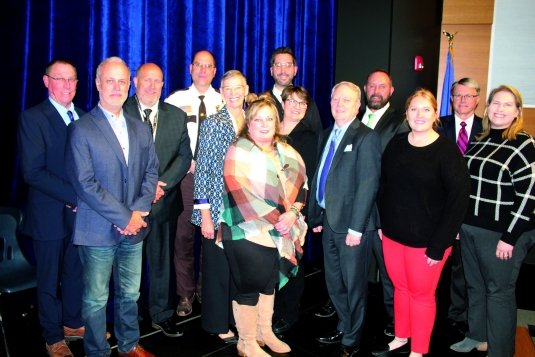
Speakers and moderators for the “State of the County” event were, from left, Brian Harguth, Randy Zimmerman, Brad Milbrath, Jay Dulas, DeAnn Malterer, Stacy Schroeder, Michael Johnson, Sarah Berry, Mikhail Rostislavovich, Chris Hinton, Jamie Beckstrand, Dwight Tostenson and Ann Fitch. Pioneer photo by Deb Bently
State of the County public address
Tue, 12/03/2024 - 8:43pm
About 50 people attended a “State of the County” session sponsored by the Waseca Area Chamber of Commerce (WACC) political committee at the Waseca Junior Senior High School performing arts center the evening of Tuesday, Nov.12.
Representing county leadership for the evening were commissioners Brian Harguth, Dee Malterer and Brad Milbrath; county administrator Michael Johnson; county sheriff Jay Dulas; public health department head Sarah Berry; and veteran services leader Chris Hinton.
After an introduction by board of commissioners chair Harguth, each of the non-elected leaders were given a few minutes to summarize the services and initiatives underway in their departments.
Harguth’s introduction mentioned the county has a population of about 19,000 people and encompasses 433 square miles of land along with nearly 10 square miles of lakes. It includes the incorporated communities of Janesville, New Richland, Waterville and Waseca, along with a portion of the town of Elysian. County government, Harguth said, is charged with looking out for the “health, safety, and general welfare” of those residents.
Sheriff Dulas reported that, in 2023, the county dispatch–which answers calls made not only to the sheriff’s office, but also, often, to city police departments–handled about 19,000 calls for service, including nearly 5,700 9-1-1 calls. He stated the department is experiencing similar numbers this year.
He stated his agency gladly collaborates with health and safety agencies from local to state to federal, and expressed his appreciation for the robust public support provided by area residents, finishing with the statement, “The Waseca County Sheriff’s office will continue to work with all of you to help keep Waseca County a great place to live, work, raise a family, and relax.”
Public health director Sarah Berry said her department “provides services where gaps exist” to “serve our residents throughout the life cycle, starting from before birth to helping the elderly stay in their homes, if desired.”
She mentioned that one department priority is delivering mental health services, since mental illness has been recognized as a rapidly growing problem across the nation.
Hinton informed the crowd his office stands ready to assist any of the estimated 1,100 veterans living within the county as well as, in some cases, their surviving spouses. He stated that, in recent years, benefits received by county veterans have brought about $10 million in federal VA resources into the county, chiefly in the form of health care.
“We’re here for you,” Hinton stated. “Please send your veterans to us.”
County administrator Johnson highlighted the county’s achievement of limiting its tax levy increases to only about six percent over the past five years–a time during which the Federal Reserve Bank of Minneapolis reports about 18 percent inflation.
He stated, “Fiscal responsibility is not a policy, it’s a guiding principle.”
He mentioned recent broadband internet grants awarded to the county will “literally flip” the 95 percent of the unincorporated portions of the county which were “unserved or underserved” to 95 percent having state-of-the-art digital access.
He complimented county commissioners saying, of all the boards he has worked with or become knowledgeable about, Waseca County’s are “the most engaged, thoughtful, and active I’ve seen.”
He pointed out that, in addition to the 24 regularly scheduled twice-monthly meetings on their official schedules, board members have attended a total of well over 100 other gatherings meeting not only with area business, government, and special interest groups, but also at the regional, state, and even occasionally federal level.
After the individual addresses were completed, panel members responded to questions supplied by both the WACC committee and members of the audience.
Among the topics raised was the status of the Waseca County Jail. The current structure does not meet state Department of Corrections (DOC) guidelines and was at risk of being abruptly closed after an inspection which took place earlier this year. While addressing that possibility, county leaders weighed the costs and benefits of building a new facility that would satisfy DOC requirements against those of severely limiting local lockup facilities and instead housing inmates at out-of-county jails.
With costs for various projects and structures meant to resolve the problems ranging from $26 million to $53 million, Johnson said the question of whether to build a new jail or justice center leads to considerable controversy “both fiscally and philosophically.”
He stated conversations surrounding the topic would be “rekindled within this coming month.”
When asked what is being done to promote “ag tourism” in the region, commissioners responded they are working with the organization “Greenseam,” out of Mankato, which promotes southern Minnesota worldwide as an area with tremendous opportunities for agriculture-related business and production.
Commissioner Dee Malterer also commented the county does what it can to “support local people who are already doing it,” meaning who have found ways to bring agriculture and ag production into the public eye. She mentioned Pleasant Creek Pizza Farm, Cedar Creek Brewing, farmers markets in area communities, and others.
Asked about trees apparently dying on Loon Lake Island in Waseca, commissioner Milbrath reported having spoken with county facilities management director Brian Tomford and having contacted the area office of the U.S. Department of Agriculture (USDA). He mentioned work is underway with the aim of selecting and installing devices meant to keep cormorants, whose droppings are particularly acidic, from nesting in the trees again next year.
Asked what they believe to be some of Waseca County’s greatest strengths, representatives cited “great opportunities for growth” including finding ways to repurpose already existing buildings; strong access to transportation with major highway systems; being in proximity to larger communities; excellent recreational facilities including city and county parks, as well as Clear Lake which is greatly improved because of weed harvesting activities; great schools; low crime; and “a lot of people who work very hard, are engaged in their communities, and love where they live.”