
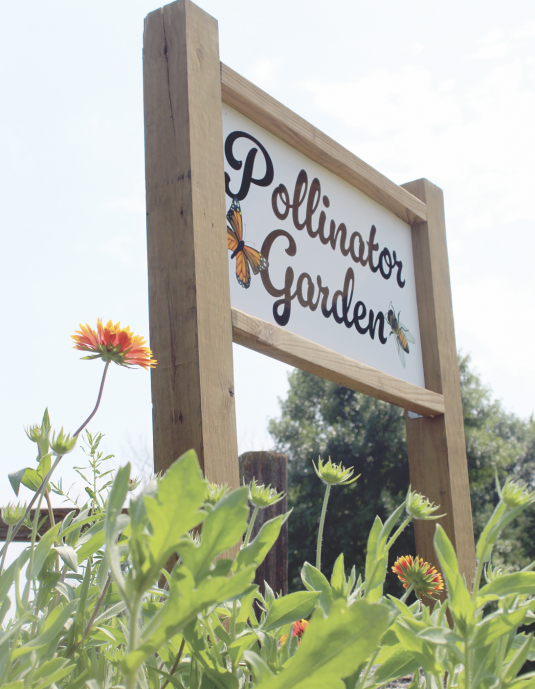
POLLINATORS WELCOME - Some of the funding which helped make the new pollinator garden at the New Richland Sportsmen's Club possible came from the New Richland Area Foundation. Rocks and Roots Landscaping of Hartland prepared the site, planted the flowers and put identifying labels in place. Pioneer photo by Deb Bently
Sportsmen’s club installs pollinator garden
Thu, 08/07/2025 - 1:15am
The New Richland Sportsmen’s Club invites people to stop by and view two updated landscape features at the organization’s grounds on the east side of Highway 13. Club members are issued keys and can open the gate; visitors can park outside the gate and walk in.
Thanks to the club’s efforts, and to $800 in support from the New Richland Area Foundation, visitors will see 15 varieties of plants regarded as optimal for pollinators–insects which forage for nectar constantly during daylight hours, and thus allow plants to reproduce. According to the Minnesota Department of Natural Resources (DNR), there are more than 500 native species of bees in the state, and thousands of different types of insects help spread pollen. The feeding habits of hummingbirds also lead to pollination.
Without this foraging, many fruits and vegetables would not reproduce.
The DNR and other agencies express concern since there seems to be a decline in pollinator populations, and sharp decline among certain species, some of which are now considered “endangered” or “threatened.”
Dave Wallin’s local landscaping company, Rocks and Roots, installed the edging, mulch and other features of the garden, in addition to positioning the 220 individual plants.
Planted in mid-June, “the flowers are doing really well,” observe Club committee members Dave Dunnett, Wallin, and Lee Mendenhall.
The three explain there is a significant difference between a garden filled with flowers and one selected especially to support pollinators. “They’re both beautiful to look at,” Mendenhall concedes. “But the flowers people plant for show are bred for size and color, with pretty much no attention paid to how much nectar they produce.”
The DNR website recommends the use of plant species native to the region.
Among the plant types growing at the Sportsmen’s Club are some well-known varieties; alongside are many that are not so familiar. Visitors will see purple poppy mallows, prairie onion, prairie sedge grass, blanket flower, prairie phlox, purple prairie clover, aromatic aster, grey golden rod and hoary vernian.
Recently installed are signs identifying each type, and a mailbox holding a reference sheet that shows the layout of the flowers.
Committee members mention that, with the installation of the pollinator garden, the size of the native prairie planting which has been on the property for about 30 years has grown smaller. It will be undergoing a multiple-season regeneration process, since invasive plants had been, well, invading in recent years.
To inhibit the unwanted plants from reproducing, the native prairie area will be mowed each of the next few summers: Seeds will be distributed to replenish the desired species.