
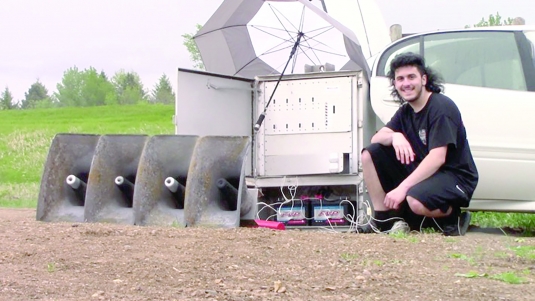
ENTHUSIAST - Siren enthusiast Chris Alywerd, 20, has made a hobby of studying and learning about sirens and the systems used to activate them. Alywerd recently took this siren to an event in Wisconsin where more than 600 people who share his interest gathered to exchange information about sirens and how they are used. Pioneer photo by Deb Bently
Siren enthusiast tells of hobby, safety measures
Thu, 06/12/2025 - 4:45am
Chris Aylward, 20, has lived in Waseca for a year and proclaims enthusiastically that he loves it here. Having grown up in a Chicago suburb where noise from a nearby highway was constant and the sounds of airplanes taking off and landing at O’Hare airport shook his family’s home, he says he loves how quiet it is in our local towns.
Which makes it seem very ironic that his hobby is sirens.
He admits it’s an unusual fascination, but goes on to say he and his circle of friends have assembled a map that shows where essentially every siren in the state is located. He also recently returned from an event named “Sirencon,” located in a fairly remote area of Wisconsin north of Rhinelander, where more than 600 enthusiasts gathered and–who would have guessed?--sounded off sirens.
“We brought in a great big generator to power them,” he explained.
For his trip to the event, Aylward strapped a siren in his trunk and crammed its electronic components into his car so that he, too, could make some noise. He has owned the siren for only a few months and has spent some of his spare time looking over and repairing its wiring. Manufactured in 1982, it was among a set of similar units decommissioned by the city of
Fairmont. When Aylward asked about them, one was offered to him for free.
He explains that, when in place, the siren had four sets of four speakers, each facing a different direction. When offered the items, he decided to take only one set.
Aylward appeared at the June 3 meeting of the Waseca County board of commissioners. During the “public comment” opportunity, he referred to himself as a “stormchaser” who is very interested in sirens and wants to see the public protected.
He offered the examples of two storm systems which moved through the county during the past 9 months; he detailed that, in one case, the storm had already struck the city of Janesville and caused damage before the siren sounded, even though the National Weather Service had transmitted its warning minutes before. In another case, the city of Waldorf was under a warning and its siren did not sound.
All county tornado sirens are activated from the sheriff’s office dispatch center, located in Waseca. Aylward shares there are six sirens in Waseca, two in New Richland, three in Janesville, and one functioning unit in Waldorf. They are positioned 50 or more feet in the air and mounted either on poles or on the tops of buildings. They are strategically located so their sounds reach all members of the community, ideally at a sound level of 70 decibels–which he compares to standing next to a vacuum cleaner while it’s in operation.
Siren units across the county are quite different from each other. They are often kept in place for decades at a time, Aylward observes, because they are not only durable, but expensive to replace. He refers to one or two in the county as being from the “civil defense era,” in other words, from the time of the cold war when Americans were concerned there might be a nuclear attack. Others are newer, but none are truly “new.”
Aylward estimates purchasing and installing a siren will cost in the range of $25,000. He mentions older, refurbished units can be acquired at a lower price, but it can be problematic linking aging technology to modern communication systems.
However, Aylward says, it is the activation system that has caused the delayed or missing warnings, not the sirens. As the system in Waseca County works at this time, the operator in the dispatch center receives information from the National Oceanic and Atmospheric Administration. Sometimes the information is straightforward; sometimes it is more complex.
“For example, the tornado warning might include Janesville and Waldorf, but not Waseca or New Richland,” Aylward offers. “The dispatcher has to refer to the information, confirm which buttons on the panel need to be pushed, and reference everything back and forth.
“At the same time, there might be calls coming in because of the weather, which will add to the distraction and confusion.”
During his brief comments to the board of commissioners, Aylward volunteered to work with county officials–if desired–to help set up a system which bypasses a human operator and activates the sirens directly.
When it comes to the end purpose of the warning system, there are some things about the sirens Aylward says he wishes every member of the public understood.
“First,” he says, “when there is a tornado warning, it is typical to sound the sirens for three minutes and then stop.
“That’s because of certain things about the sirens themselves. They’re made to operate for about three minutes at a time.
“So when the siren stops, that does not mean the emergency is over. People should still be taking all the steps needed to stay safe.”
Given the many modern forms of communication available, Aylward acknowledges sirens may seem somewhat archaic. He claims, though, that they continue to be vital to public safety because they reach everyone within a community–especially those who do not happen to be watching television, listening to the radio or using their smartphones. “Maybe they’re outside doing some gardening and they left their phone inside,” he offers as an example.
In Waseca County and in most communities, the siren indicates it’s time to take shelter. While doing so, Aylward suggests, they can also acquire further information from other sources.
Sirens are tested once a month, he goes on to say, because they are sophisticated devices with a vital role in public safety. During the test, there is often someone whose job it is to move among the different sirens and confirm they are operating properly. Equipment may be used for this, he adds, or the person may simply be watching and listening to the apparatus–which is much more sophisticated than a simple loudspeaker or horn. Many actually use a specially designed fan to create the sound, which is then amplified by the shaped shell.
A change in tone may indicate the equipment needs attention.
Aylward notes he is acknowledged among his fellow enthusiasts for being especially good at recognizing the desired pitch for most types of sirens.
He points out there is a statewide siren test in the first half of April each year. He suggests, “Don’t just ignore that. Use it as a motive to consider where you would go to be safe if the siren sounded at this time of day.”
Though this is not true in Waseca County, Aylward mentions sirens can be used in other ways in different communities. In some, he says, the siren indicates firefighters should report to the fire hall. In places where a town is below a dam, there is often a separate siren with a separate tone meant to warn if there is emerging danger having to do with the water. There are even communities where sirens are used to announce night time curfews.
“Sirens are specialized equipment that has been kept operating to protect the public,” he comments. “People should do their part to know how to respond to them, so all the trouble and expense will be worth it.”
Aylward invites anyone who would like to learn more to visit his YouTube channel: Siren dude1003.