
Shallow waters
Oxygen readings of area lakes reported
Oxygen readings of area lakes reported
Fri, 02/10/2023 - 1:35pm
“It doesn’t work to take lake water and study it in a lab,” observes George Klug. “You have to study it where it’s at.”
Klug is working with a team of scientists to study shallow lakes that are prone to fish kills and applying summertime aeration to get ahead of the winter problem with oxygen. He and his team devised the aeration project that cleared Waseca’s Loon Lake this past summer of the filamentous algae which has plagued it throughout the memories of any living Wasecans. He notes that he will be installing that same system in April this year, rather than waiting until summer.
In an article which appeared in the Pioneer last fall, Klug observed that filamentous algae is particularly damaging to oxygen levels in the water because, as the plants die and begin to decompose, the rampantly reproducing bacteria deplete the supply of dissolved oxygen in the water, stressing other life in the lake and reducing its chances of survival, especially as the lake freezes over and is capped by ice and snow cover.
“The decomposition continues all winter long,” he explains. “Oxygen levels respond to that.” Klug describes the health of a lake as resting on a line of closely intertwined factors. The element with the most dramatic impact is the amount of available oxygen.
Having used aeration this past summer to reduce the overgrowth of plants, Klug has been studying oxygen levels this winter in five area lakes whose water is 10’ or less deep: Loon Lake in Waseca, Lake Elysian near Waterville, Eagle Lake near Mankato, and Crystal Lake and Loon Lake, both in Lake Crystal.
“The news is not good,” he reports. “They’re all in tough shape.”
According to information shared by the Minnesota Department of Natural Resources, anything below 3 parts per million (ppm) of oxygen is too low to support fish life, and is likely to result in a “fish kill.” Fish can survive on 3-5 ppm for a short time. Levels of 6 ppm support spawning, and “abundant” fish life becomes viable at 9 ppm and above.
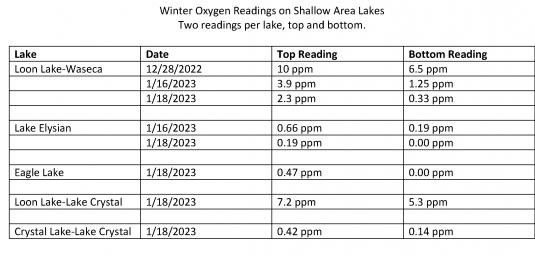
As can be seen by the chart published with this article, Loon Lake in Waseca had 10 ppm of oxygen near the surface on December 28, and 6.5 ppm closer to the bottom. In less than a month, however, levels fell dramatically, despite aeration units having been operational since early January.
The story is much the same in Lake Crystal’s two lakes. Both have aerators, and both have falling levels of oxygen. To Klug’s confusion, back on January 18, Lake Crystal’s Loon Lake had fairly strong oxygen levels (although they’ve been falling), while Crystal Lake had less than 1 ppm–even though the lakes are connected to one another.
“My objective in sharing this information is to provide the public with accurate information about developments in shallow lakes,” says Klug.
As is well known, shallow lakes are at higher risk of “freezing out” than deeper ones. But the reasons are more complex than “simple logic” might dictate.
“At least in a way, telling people we don’t know is being accurate,” he jokes.
Deeper lakes, he explains, have strata of water levels which maintain certain temperature ranges. This tends to limit the amount of exchange that occurs between layers.
Shallow lakes, on the other hand, experience what’s known as “rolling.” Thunderstorms, heavy rain, and other atmospheric conditions which deliver colder water on top of the warmed lake water cause the cooler water to sink to the bottom and send the water from near the bottom of the lake upward. During the exchange, nutrients released from the soil near the bottom migrate to the top. This wider distribution of nutrients leads to a much different biosphere from that found in deeper lakes.
When it comes to the “state of the biologics” in the water, Klug says, “We learn something every time we go out.” He plans to continue collecting data on these shallow lakes in hopes of enriching his understanding of what can be done to protect them.
In the meantime, as dismal as the low oxygen numbers may seem to be, Klug points out that nature often defies prediction. For example, Waseca’s Loon Lake had experienced a fish kill during the 2021-22 winter. Yet, while fishing there this past summer, he caught fish which were too large to have reached their size in a single season, and thus were at least two years old.
Speaking of “defying prediction,” readings from the two lakes without aerators (Elysian and Eagle), do not always differ much from those which have them, even though the readings are taken close to the open water created by the aerators on the other three.
Klug recommends that readers curious about the status of any certain lake can make use of a tool provided by the DNR which provides a “health” rating and selected data for most Minnesota Lakes. The tool can be found at https://www.dnr.state.mn.us/whaf/about/watershed-reports.html.
He comments that the tool may be valuable to others who are beginning to take an interest in some of the questions he’s been studying for the past 7 years. Truly understanding the biologics of a lake, he comments, is as complex as trying to build an apple from its many components, from submicroscopic structure to flavor and texture.
“But that doesn’t mean we can’t make a difference,” he says. “We’ve made some very valuable progress, and we’re taking the steps we need to make even more.”