
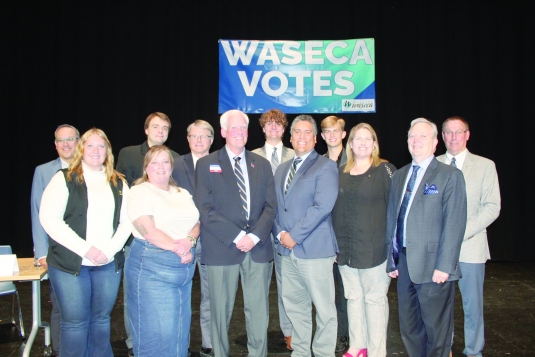
Participants and organizers of the Waseca Votes district 19B debate, from left: Larry Johnson, Jamie Beckstrand, Eli Lutgens, Stacey Schroeder, Dwight Thostenson, Tom Sexton, Brayden Hoof, Edel Fernandez, Nathaniel Howe, Ann Fitch, Mikhail Rostislovovich and Brian Harguth. Pioneer photo by Deb Bently
Sexton, Fernandez seek District 19B seat in Minnesota House
Wed, 10/23/2024 - 8:05pm
Candidates running to represent the Medford/Owatonna/Waseca area covered by Seat 19B of the Minnesota House of Representatives met in a debate sponsored by the Waseca Area Chamber of Commerce legislative committee the evening of Tuesday, Oct. 8, at the Waseca high school performing arts center. About 120 people were present.
In the case of this race, neither candidate is the incumbent since both are running for a seat held for the past 12 years by Republican John Petersburg. Petersburg announced earlier this year that he did not intend to run for reelection.
Five questions selected by the legislative committee were posed during the first half of the debate. Once responses and rebuttals to those had been heard, members of the audience were invited to submit questions. From those, another five questions were addressed to candidates.
On the stage were Democratic candidate Edel Fernandez and Republican candidate Tom Sexton.
Audience members received a program which provided self-written introductions to the two men.
Fernandez, 50, is a resident of Owatonna running for an elected position for the first time. He works as the director of admissions for South Central College and divides his time between the Faribault and Mankato campuses. Having been born in Guanajuato, Mexico, he is a naturalized United States citizen who has lived in Minnesota for more than 24 years. He has a bachelor’s degree in communications and public relations, is father to three children ages 13, 16, and 20, and has served on numerous boards and committees including those of the Owatonna Public Library, Owatonna Soccer Association, and Big Brothers and Big Sisters. He is a member of the Rotary Club.
Sexton, 76, is a resident of Waseca who retired from 26 years of service with the United States Air Force as a Colonel in 2012 before working as a facilities construction manager in the petroleum industry for nine years. He and his wife of 38 years, Jeanne, returned to their family roots in the Waseca area in 2021. Tom took on volunteer roles with the planning commissions of both the city and county of Waseca; he chaired Waseca’s LakeFest celebration in 2023 and 2024; he is a member of both the American Legion and VFW and serves on the Legion’s Honor Guard. He has a bachelor’s degree in business administration from the University of Minnesota, has earned master’s degrees from three military programs, and was a Military Professor for four years at the U.S. Army War College.
Both men shared during their opening remarks that they decided to enter the District 19B race after others suggested or requested that they do so.
In his responses to questions, Fernandez emphasized one of his campaign slogans, “Working together, winning together.” He emphasized the importance of education and access to broadband internet. He mentioned that he has taken part in efforts to create a wastewater agreement between Medford and Owatonna, and stated that experience has helped him see how complex the issue can become. Regarding these topics and others, he stated it is very important that residents communicate with their elected officials so that they could “bring our shared southern Minnesota values to St. Paul and work across the aisle.”
Among repeated themes in Sexton’s responses were criticisms of how, instead of “being returned to taxpayers,” the $55 million state tax surplus was spent in ways that “keep growing the government larger.” He claimed a significant part of the $2.2 billion funding for education was retained to “build an empire up in St. Paul” rather than being distributed to school districts. He also pointed out the current legislature did not follow its typical practice of creating this year’s expected “bonding bill.” Without the funding bonding would have created, Sexton said, matters of infrastructure—highways, wastewater treatment, and other important local projects—were not given their due priority.
When asked about funding for emergency medical services, both candidates expressed wholehearted support for the necessary work done by public safety workers. Fernandez told of how he nearly drowned four years ago and praised the safety workers who happened to be nearby and spontaneously used their skills to help. He cited a recent allocation of $300 million toward public safety and crime fighting programs.
Sexton drew attention to his endorsement by the state association of law enforcement officers by citing that Minnesota police and sheriff departments have about 1,000 open positions at this time, with another 2,400 officers approaching eligibility for retirement. He stated it is among his top priorities to help improve the opportunities and incentives individuals have for entering the field. Two additional priorities he named are “getting a handle on the budget” and preventing funds from being used to “grow bigger government.”
Fernandez said he also supports closer scrutiny of how tax money is managed, saying government needs to “find a balance which will help Minnesota grow.” He said he would want to work toward more transparency while also ensuring spending is fairly distributed among rural and urban areas.
Asked abut abortion, Sexton stated he is “unashamedly pro-life,” but suggested he would not be able to change the state’s current stance on the issue. He would focus his efforts instead, he said, on protecting women’s safety. One example he offered is that he would like to see any abortion procedures limited to hospital settings.
Fernandez responded to the question by saying of the Democratic party’s and his personal position, “We are not pro-abortion, we are pro-choice. We believe abortions should be rare, but for those who make that choice, they should also be accessible and safe.”
Both candidates agreed there should not be income tax levied against Social Security payments. Fernandez mentioned the fixed income seniors receive has already been bitten into by recent high inflation. Sexton said, “Our seniors helped create the great lifestyle that is part of our society. Let’s let them enjoy it.”
Another point of agreement was a response both candidates gave regarding voters’ largest concerns. Both told of their encounters as they are out “knocking on doors,” saying they receive repeated feedback about the divisive state of politics. “People are sick and tired of the polarization,” said Fernandez.
Fernandez mentioned he also consistently hears voter concerns regarding inflation and people’s ability to “make ends meet.” He named the availability of family housing, education, and access to affordable health care. The aging population, he said, makes the role of immigrants increasingly important as they attempt to “put down roots in the community” and become part of American society.
Sexton also named the economy as a significant voter concern, including finding ways to “stabilize” it and reduce inflation. He mentioned the mental health crisis and the many extra demands it places on law enforcement and public safety workers.
The final question for the evening, one selected from among those submitted by audience members, asked whether the candidates would be in favor of ending “daylight saving time.”
Though both candidates expressed personal leanings toward eliminating the practice, they also commented they would want to perform further research if they were actually asked to vote on the topic.
“If it was an easy decision made for easy reasons,” commented Sexton, “we would have made it long ago.”