
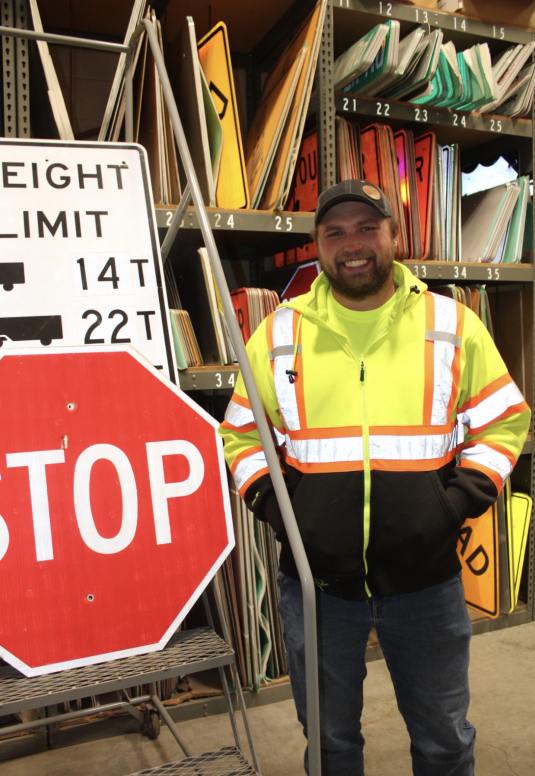
SIGN EXPERT - Joe Barbknecht is the "sign man" with the Waseca County Highway Department. It's his job to be sure all the various signs needed along county roads are in place and in good condition. Pioneer photo by Deb Bently
Rules of the road
Signs are one step in safe driving
Signs are one step in safe driving
Thu, 11/06/2025 - 1:30am
The Minnesota “Manual on Uniform Universal Traffic Control Devices” (MUTCD) is more than 1,000 pages long. There are rules for how large signs should be based on their location and purpose, rules about how they should be spaced, and rules about not having too many of them so that drivers don’t become overwhelmed and stop paying attention altogether.
Keeping Waseca County’s road signs in place is the job of Joe Barbknecht with the county highway department, who has had the job for about three years. He points out the task does not occupy all of his time–after all, signs typically last 12 years or so, and some he has replaced have been more than 30 years old. But things do happen.
“The wind plays a major role in the lifespan of signs,” he comments, pointing out that a rocking motion can gradually increase the size of the openings used to mount a sign to a post, eventually making them large enough to slip right over the heads of the mounting bolts.
Signs and posts are of course also occasionally damaged in traffic incidents, although Barbknecht states this is a rare occurrence compared to the work of everyday repairs and general upkeep.
Similarly, he says vandalism and theft are not common: The county has made the decision, though, to replace any missing “420th Avenue” signs with simply “42X Avenue,” given the number 420’s association with marijuana use and the number of those which have disappeared.
The county keeps hundreds of signs in stock, organized on a set of shelves about 24 feet long, 10 feet tall and three feet deep. Alongside “Stop” and “Yield” and “Speed Limit” signs are bright orange “Detour” and “Caution” indicators. Barbknecht points out some are there for quick replacements when needed, others are kept for use in construction or emerging situations.
In some cases, he mentions, stored signs can be modified in-house, for example by adding an arrow pointing the appropriate direction to indicate a detour.
When signs are needed that are not already on his shelves, Barbknecht mentions he must order them from specialty businesses. Turnaround time is typically three to four weeks. The signs are made of aluminum coated with an adhesive-backed reflective sheeting.
He explains signs are so reflective because “micro-prisms” are built into the sheeting creating “retroreflectivity”: In other words, the light of car headlights is reflected back at the car.
When a sign is meant to remain in place indefinitely, it’s mounted on a specially constructed steel pole which is set at least 3.5 feet into the ground using a hydraulic pounder. When an old sign must be removed, a hydraulic puller is used.
Barbknecht says the largest signs the county highway department is likely to use have a surface area of about 3 by 6 feet; for large jobs like those, the “sign truck” has a crane.
Perhaps obviously, the construction season is much busier for Barbknecht than the remainder of the year. He is responsible for ensuring proper signage is in place when county crews are working on roads or completing projects. It’s not as busy as it might be, however, since the bids for tasks taken on by contractors usually include posting the needed signage.
In conversation about his job, Barbknecht comes across as someone who simply takes things in stride, coping with situations as they arise, admitting only that some days are busier than others.
“Signs are important,” he acknowledges. “We do everything we can to be sure they’re in place and in good repair so people can make safe driving decisions.”