
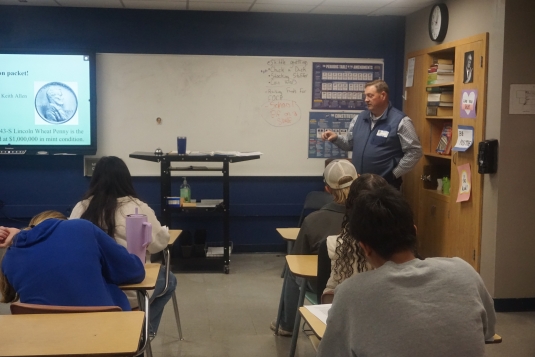
Rep. Keith Allen of legislative district 19A visited with senior students from JWP on Nov. 7.
Representative Allen visits JWP
Thu, 11/20/2025 - 1:15am
Representative Keith Allen of legislative district 19A visited with the senior students from Janesville-Waldorf-Pemberton (JWP) school district during their social studies class with Blake Frink on Friday, Nov. 7. The topics they covered ranged from curiosity about Allen’s political life, affordability of college education and childcare, and street infrastructure on the state and local level.
Allen graduated from Dover-Eyota High School in 1996 and attended Hawkeye Community College to take advantage of a scholarship before going on to the University of Minnesota in the Twin Cities from 1998 to 2002. He earned a bachelor’s degree in animal science. Throughout his life, he has worked extensively in agriculture and farming, customer service, sales, and management. A few years ago, he launched a seed business called Allen Seed Source.
“I was very interested in politics, specifically centered around policy and how rules and laws are crafted and how it actually gets implemented and how people are affected by it,” Allen stated. “I was on the Farm Bureau and very active on that side of it.”
He went on to say he has been disappointed seeing that national and state committees frequently make rules without presenting questions to farmers about how they run their businesses. So, he added, these laws can negatively affect farmers and can become frustrating.
Congressman Brad Finstad, who Allen attended college with, reached out to Allen when the farm bill was rewritten and asked him to work for him since they both were knowledgeable in agricultural business. When representative Brian Daniels decided to retire from his position, Allen decided to throw his hat in the ring.
“Not all congressional jobs happen in D.C.,” Allen pointed out. “They do happen here in the district.”
Allen went on to say he conducted more than sixty listening sessions with stakeholders who were involved in the Farm Bill in areas like food service and cafeterias in schools, Supplemental Nutrition Assistance Program (SNAP), manufacturers, and farmers. He said the data was an important foundation in a new version of the Farm Bill which is still waiting to be passed.
“What does a typical day look like in St. Paul?” Frink asked Allen.
“I am slammed with a pretty tight schedule,” Allen responded and added that his day starts at 7 a.m. He has committee meetings with hearings following at 8. “On an average day, I get maybe 15 minutes to a half hour to myself to look at some email.”
If anyone notices during a committee meeting that he is on his computer or phone, Allen said he’s doing his best to keep up with what’s happening in the district from all the emails he receives.
“When we’re in session, people want to make sure that their voice is heard,” Allen stated.
He also shared that last year, the House worked at setting budgets starting in January through the end of May. Alongside that process, Allen said bonding is set and policies are reviewed, but this next year, session will begin in February and focus more on policy.
When one student asked what the rewarding part of a job as a representative is, Allen said he enjoyed crafting a policy that works and seeing its results.
“Too often we write law and write rules that don’t necessarily do what they’re intended to do,” Allen said. “We can see that with mandates that were thrown on education and the impacts it has there. What we see for regulatory stuff like building permits and agriculture – is making sure people are heard.”
Noting that his whole social studies class is in their last year of high school, Frink asked Allen about the affordability of a college education with a four-year degree.
“On the higher end, that’s something that our committee is wrestling with,” Allen said. “It is not cheap to go to college. When you get out of college, there’s the question if there will be a spot for you to get hired.”
He also noted that the costs and needs for a college or university are going through the roof and stated commitment to entities such as the Minnesota State System.
“The Minnesota State University is more than happy to remind us in the legislature on a regular basis that they’ve been around longer than we’ve been in existence,” Allen said. “They were founded long before our state was. It's always kind of an interesting conversation to have with them, but they’ve been a very good partner, regardless.”
If the legislature can keep on top of its bonding, bonding requests and funding for universities, Allen added, he hopes that will help keep the tuition rates in check. However he said, there’s not much to do in the short term since colleges and universities keep accruing debt.
When questioned why the costs for education, Allen responded there have been numerous factors such as inflation and maintenance of facilities.
“The one thing we’ve never talked about in the university system but the process they’re going through is reevaluating maintenance facilities and maybe getting rid of them,” Allen stated. “It takes a whole pile of money to maintain some of these older buildings and it’s not worth maintaining them.”
Instead, Allen said the universities are looking at building new classrooms with more flexibility, and heating and cooling efficiencies, and reevaluating their programs.
A student inquired whether the legislature has any plans to ensure the safety of Highway 14 and Highway 60, given recent disastrous accidents.
“That would qualify for what’s called a highway trunk and I’m not on transportation, so I’m not sure if that’s on the radar for them,” he said. “I know on bonding, we did a construction project on Highway 14 over by Byron which would put in two new overpasses, one off ramp one overpass.”
Frink posed a follow-up question regarding what regular citizens can do so if there is interest for any change in the highways.
“Putting it on my radar is a good way to start so I can start a process of talking about what’s going on and advocating it to a committee,” Allen said and suggested anyone could bring it to the attention of county commissioners also.
In closing, Allen left any students who might be interested in government with some resonating advice.
“Be curious and see what’s out there,” he said. “Find out what you’re passionate about and see how that can help you as far as different intersections of government. If you’re really interested in it, you can intern as a page. It can be an interesting way to see behind the scenes and know what you’re getting yourself into.”