
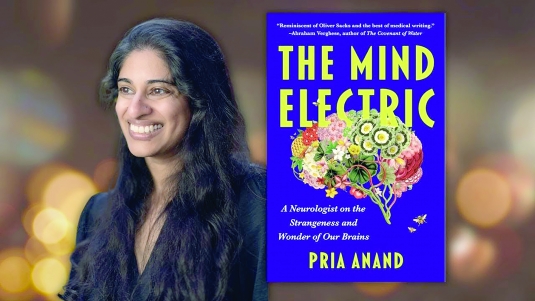
WONDER OF OUR BRAIN - Author Dr. Pria Anand virtually presented her book, “The Mind Electric: A Neurologist on the Strangeness and Wonder of Our Brains” courtesy of the Waseca Le Sueur Library System on Thursday, July 31.
Online library presentation looks at 'The Mind Electric'
Thu, 08/07/2025 - 12:45am
Author Dr. Pria Anand recently appeared virtually, courtesy of the Waseca Le Sueur Library System on Thursday, July 31, to talk about her book, “The Mind Electric: A Neurologist on the Strangeness and Wonders of Our Brains.” Anand is a neurologist at the Boston Medical Center and an assistant professor at the Boston University School of Medicine. The online interview was conducted by Brandon Adler, who is a lawyer and librarian by training, as well as an adjunct professor at the University of New Orleans. The conversation was live, allowing Anand to take questions from anyone who signed up in advance.
An online description: “In The Mind Electric,” neurologist Pria Anand reveals—through case study, history, fable, and memoir—all that the medical establishment has overlooked: the complexity and wonder of brains in health and in extremis, and the vast gray area between sanity and insanity, doctor and patient, and illness and wellness, each separated from the next by the thin veneer of a different story.” In her training to become a doctor according to her website: her work experience meant moving from the Boston hospital where she treats her patients, to her childhood years in India, to Isla Providencia in the Caribbean and to the Republic of Guinea in West Africa, she demonstrates again and again the compelling paradox at the heart of neurology: that even the most peculiar symptoms can show us something universal about ourselves as humans.
Elizabeth from Waseca County asked, “Can you mention something about infrequent audio hallucinations and how they present as a precursor to a seizure.”
Anand replied, “There are many different things that can cause phantom sounds. One of the strangest manifestations of a seizure happens when there is abnormal electrical activity in the brain. One of the parts of the brain most susceptible to seizures is the temporal lobe where the audio cortex is. Sometimes people will hear certain voices or certain chords of a song. They go to a doctor, and they say, “I’m hearing these three cords.” And the doctor will reply, “Okay, what do you want me to do about it?” It’s not something that people can outwardly manifest, that people can look at and know it’s a seizure.”
Brandon Adler asked, “How does neuroscience explain DeJa’Vu?”
Anand responded, “One theory is our memories are formed in our hippocampus, we have two, which are named after the Greek word for seahorses because they curl like seahorses, and we have one on each side. One hypothesis is memories are formed in these two structures but it’s possible we access one memory just before it’s activated in the other, or a particular sensation will activate in one before the other. Somewhere below in our unconscious, that dissonance between one half before the other, this gives us the sensation that we’ve done that before, or seen that before or heard that before, giving a person this false sense of familiarity. Either that or it’s magical: That’s one other hypothesis.”
This event was made possible by the voters of Minnesota through a grant provided by the Traverse des Sioux Library Cooperative, thanks to a legislative appropriation from the arts and cultural heritage fund. The event was held in coordination with Library Speakers Consortium and presented by Waseca-Le Sueur Library Systems.