
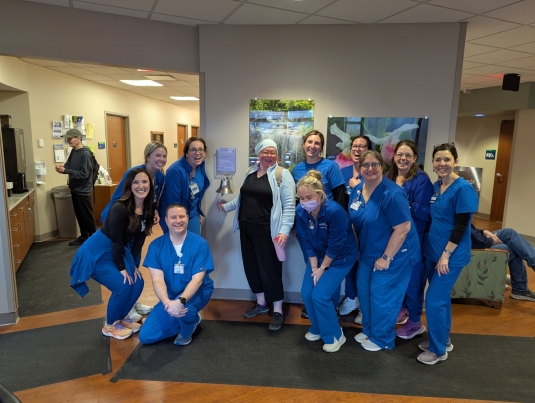
CHEERING LOUD - Waseca resident Kathy Youngberg completed a treatment regimen this month that included chemotherapy, surgery and radiation. She is pictured here with the team of nurses who helped her through chemotherapy, ringing a bell that celebrates the end of that type of treatment.
Kathy Youngberg rings the bell
Thu, 10/30/2025 - 12:10am
“I wouldn’t wish it on my worst enemy,” says Kathy Youngberg about the past 13 months. “It’s scary, it’s uncomfortable, it can lead to embarrassing moments.
“But it’s not the end of the world. You can get through it.”
Youngberg, 54, is a lifelong area resident with two grown sons: Oliver, 25; and Henry, 26. She says she had noticed some discomfort and located a lump during self-examination the summer of 2024, and so wasn’t surprised when her regularly scheduled mammogram indicated some suspicious tissue in her breasts. After a biopsy and further tests indicated she had stage one breast cancer that had not yet spread to her lymph nodes, she embarked on a three-part treatment program that September.
“My reaction wasn’t anger and it wasn’t self pity,” she remembers. “It was that I wanted to get it taken care of and then continue my life so I can be here for my loved ones.
“My personality is that I like to cope with things using humor. I also believe it doesn’t do any good to worry, so I moved ahead the best way I could. You have to take everything day by day.
“I made a lot of new friends,” she says lightheartedly of the many people from various fields of expertise she spoke with after being diagnosed. In addition to oncologists, she names a dietician, a financial aid advisor, a social worker and a physical therapist.
The first 8 months or so of treatment were chemotherapy.
“It’s not one size fits all,” she mentions. “The ingredients in the chemo are specially chosen for each person’s situation.”
For 12 weeks, Youngberg reported for chemotherapy once a week; for the next 12 it was once every three weeks. Youngberg expresses gratitude that her mother, Deanna Bendix, was able to provide company and comfort during many of her sessions.
She describes another personalized element of her treatment. “I didn’t lose my hair,” she describes, “because I wore a cold cap.” She explains a custom-fit cap with circulation channels all through it was placed on her head and hooked to a machine which kept cooled fluids flowing throughout the session. The process lowered the temperature of her scalp beginning a few hours before chemicals were delivered through her port, and continued for a few hours afterward. The lower temperature meant circulation to the skin and hair follicles there was reduced, and so she retained much of her hair.
She expresses gratitude to her employer, Federated Insurance in Mankato. “They were wonderful,” she observes. “They let me take time off when I needed to, and they allowed me to work from home part of the time.”
Though the sessions and her body’s reactions to the chemicals were difficult, Youngberg says she feels they went as well as could be hoped for. The major after effect she remembers is fatigue. “I would be sore and tired, and I would want to sleep all the time,” she recalls.
After the 24 weeks of chemotherapy, surgery removed the lump, which had decreased in size by half since it was first measured. A lymph node was also removed; testing showed the cancer had not infected it.
Youngberg says it was her decision to have a “lumpectomy” rather than more radical surgery. She said she felt comfortable with the choice after she had conferenced with her doctor and been able to consider his input. Recovery time for the lumpectomy was one week, she mentions. Typical recovery time for a mastectomy is about a month.
She shares that much of her treatment took place at the Andreas Cancer Center in Mankato. She says she appreciated the consistency of traveling to the same location and working with the same nurses and staff.
The Andreas Center has the custom of inviting patients to ring a bell when they complete crucial phases of their treatment. In Youngberg’s case, after chemotherapy, after surgery, and after radiation.
Her radiation treatments were daily for 19 days. “It took more time to undress for the treatments than it did to finish the session,” she remembers, estimating treatment time was about three minutes.
She mentions that, since she has fair skin, technicians had to take precautions to prevent “sunburn-like” burns.
Radiation also came with a different type of fatigue. “It would be like ‘boom,’ I have to sleep right now,” she remembers. “I would just unpredictably shut down.”
Youngberg rang the bell on her radiation treatments on Oct. 14. She is immensely grateful she is now cancer free. She says she will be monitored closely for the next six years to see whether there are any signs the cancer might be returning. This will include more frequent mammograms and certain lab tests.
Youngberg expresses gratitude for her health insurance, mentioning that the surgery and treatments which took place during 2025 came to a cost of more than $400,000.
She offers some advice to others.
Her first point is to be consistent about performing self examinations and about getting mammograms regularly. “Breast cancer is not hereditary, so you can’t think that, just because no one in your family has had it, you’ll be okay,” she comments. “If cancer is going to turn up, you want to know about it as soon as possible and get it taken care of.”
She also recommends finding a broad–based support system. She says people will want emotional support from family or friends, and shouldn’t feel shy about looking for financial support from the many agencies that offer it. She notes that, despite the high costs involved, money should not be people’s biggest worry.
She also suggests not using an online search engine to look up information. She describes a couple of times when she encountered unfamiliar terms and referred to an electronic source for more information. “It was shocking. I was confused and frightened because the information was sort of a worst case scenario.
“I say, use the official information they give you, and ask your care team. Don’t look it up online.”
As much as possible, she also recommends maintaining a positive outlook. “Worrying won’t help,” she points out. “Being optimistic and finding the bright side will help.
“It’s not the end of the world. Ask questions. Find people you can talk to. Find all the positives you can and plan to stick around for the life you are meant to have.”