
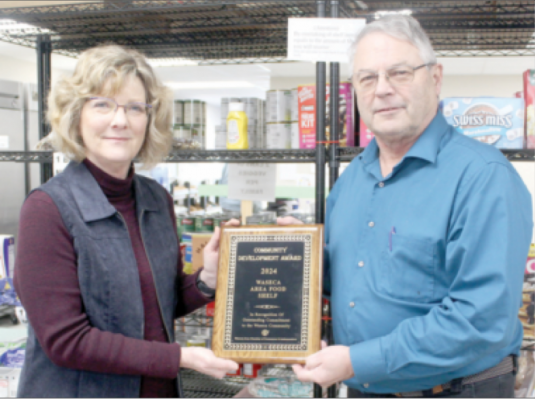
Cindy Kolander and Jim Britton with the Waseca Area Food Shelf’s Commmunity Development award.
Helping in so many ways
Waseca Area Food Shelf
Waseca Area Food Shelf
Thu, 05/16/2024 - 12:50am
Since June 2023, Cindy Kolander has served as the Executive Director of the Waseca Area Neighborhood Service Center (WANSC). Organization board member and volunteer Jim Britton has also played an integral part in this non-profit organization for a decade, including work done while he was still the owner of Britton Plumbing.
“I love that our organization is able to help so many people improve their lives in so many different ways,” Kolander said about her position. “I also enjoy meeting all the people who come into the thrift store or food shelf,” she says, mentioning pleasant exchanges with shoppers, volunteers, paid staff and board members.
According to histories Kolander has researched, WANSC began by forming a social circle around people who came to share garden produce, conversation, and used clothing. In 1982, WANSC was incorporated as a private, non-profit agency; an emergency food shelf and supplemental senior food program were founded at the time. In 1988, the center purchased its current building at 203 Third Avenue NW in Waseca; the facility was renovated to permanently house the thrift store. The food shelf, now located at the same address, was operated out of the Eagles’ building at that time.
In 2021, the Eagles building was sold and the food shelf had to look for new accommodations. The WANSC board of directors looked for a suitable new location, but nothing ideal was found.
Given that the WANSC already owned the empty lot to the west of the thrift store, organization directors voted to construct a new building there. Groundbreaking took place in Spring 2022. Until the new building was ready, food shelf services were offered in a space on the lower level of St. John’s Church in Waseca. The new building opened in December 2022.
“We had a tremendous crew to help us move from the church basement to [the new building],” Britton said. “We had football players help – the ninth- and tenth-graders – they blew me away. They got everything moved and they asked questions. Some of them even came back and did some volunteering.”
Among those who ensure the shelves are stocked and customers are helped are volunteers and paid staff who are integral to the organization’s operation. On hand to share their observations were Niki Shafer and Garry Huckfeldt. There are also many more volunteers and other staff members the food shelf relies on.
“Once you feel the compassion of someone who appreciates [the service and food] and respects it, it makes it all worthwhile,” Huckfeldt said.
Shafer noted that sometimes the people who come in just need someone who will talk with them and share conversation.
“Not many people get a chance to socialize,” Huckfeldt agreed. “Have fun, joke around, and whatnot. It makes their day.”
Kolander overheard one person thank Shafer for listening and how much it meant after a 20-minute conversation.
“It sounded like she had a hard day and needed to talk to someone,” Kolander said. “We aren’t professional counselors, but we are good listeners.”
She asked Shafer how often something like that happens.
“I would say daily,” Shafer responded. “You don’t know what that person is dealing with and what they’ve been through.”
“We couldn’t [operate the food shelf] without volunteers,” Britton said.
Over the years, Britton says has witnessed an increased need for food due to numerous factors. He told about a family who came in last summer and broke his heart because of the overwhelming verbal gratitude each member expressed, including the children. The food shelf gave them a chicken, a 25-pound bag of rice, and cereal.
“No one should go without food,” Huckfeldt said. “If you need it, come get it. It’s what we’re here for.”
“We just have to keep getting the word out because people don’t know about the need,” Kolander said, then stated that back in January, the food shelf helped supply 417 families. “And that’s just families,” she added.
Even from statistics of five years ago, Kolander noted that the need has tripled.
“When I look at stats across Minnesota and I get on calls with other food shelves – everyone is struggling,” she added. “I think the food shelf suppliers are wondering, ‘Where do we get this extra food?’ because we can’t keep up with demand.”
To keep its operations as smooth as possible, the Waseca food shelf has clients set up weekly appointments when employees like Schafer help them; to keep track of its services for various reports, the food shelf weighs how much food each client takes home.
“We certainly appreciate donations, but we have to buy like a grocery store does and sometimes we aren’t able to get protein like hamburger or chicken,” Kolander said. “We do have a good relationship with Dean’s Meat Market.”
“I can’t say enough good things about New Richland, too,” Britton added.
“A farmer – I don’t know who – donated a hog to us,” Kolander said. “That really helped.”
Kolander also mentioned a challenge over Christmas issued by the Waseca High School student council. That drive brought in 2,000 pounds worth of food. Britton described how the high schoolers set cereal boxes in a line like dominoes on the gym floor.
“The school has been really good to us,” Britton said.
Both Britton and Kolander encourage donations of money as well as of food items. Kolander explains the WANSC can make bulk purchases at discounted rates, so that donated cash may end up putting more food on the shelf than the same amount in food products. In the summer, Britton says he loves seeing all the fresh produce that the community brings from their gardens.
Huckfeldt added that every last penny WANSC makes goes back into the food shelf.
“This is a giving community,” he said.