
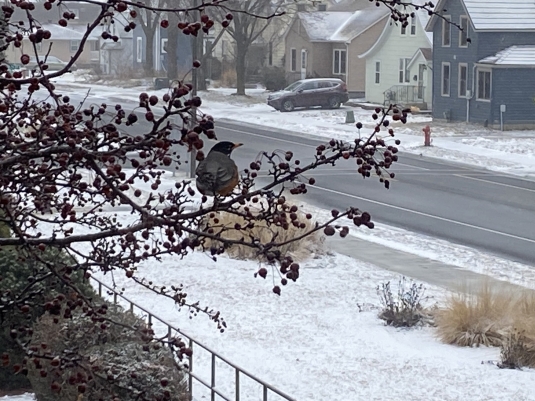
This robin was met by a snowstorm shortly after arriving in Minnesota. Fortunately, it found a crabtree full of dried fruit.
Feathered travelers are numerous and varied this year
Sun, 06/16/2024 - 5:48pm
“It’s spring here, but it isn’t everywhere,” observes Jeanine Vorland, area wildlife manager with the Minnesota Department of Natural Resources (DNR).
Vorland notes that anyone thinking “there are a lot more birds around than normal,” is correct. Migratory birds are working their way northward; generally speaking, she says they are three weeks to a month earlier than typical. As they move, they are making decisions about where they will build nests and raise young. Many have stopped to enjoy the food available thanks to Waseca County’s open water and snowless fields and lawns, but that doesn’t mean they will be staying.
Vorland reveals that as many as 350 species of songbirds have been “documented” in Minnesota, but “most are not resident.” She also shares that, of the 25 or so species of waterfowl which come through the state each spring, around a third have their hopes set further north, even as far as the arctic, for their summer nesting. Even among birds with less lofty intentions, far fewer than half will stay in the area.
Species of waterfowl likely to nest in Waseca County, Vorland says, are trumpeter swans, Canada geese, mallards and wood ducks. A small concentration of merganser ducks and teal is also to be expected.
Regarding how birds know it’s okay to move northward, Vorland says many of them have not come all that far, having wintered in Missouri or Illinois. There is a general correlation, she said, between how far they have come and how early in the season they arrive. Among waterfowl, the shorter-distance travelers are Canada geese, ringneck ducks and gadwalls. Greenwing teal, with a typical adult size “only a little larger than a robin,” also travel a relatively short distance and are “among the earlier migrants to return in spring and the latest to leave” in fall.
Among this group, “It’s not uncommon for them to catch a good south wind and travel north to have a look around,” Vorland said. “If things don’t look so good, they go back southward.”
Migration is an “energy intensive” task for the birds, Vorland says, so a short-term setback like the recent snowfalls may not be enough to send them away. “They can hunker down and weather a few days,” she comments. “It won’t be pleasant for them, but they'll be fine.”
Birds who winter as far away as Texas or even South America are what Vorland refers to as “calendar migrators.” They are unlikely to arrive much ahead of or behind their typical time. “They can’t just turn around and go back,” she observes. “So they have to be certain their habitat will be ready for them.”
All these travelers, of course, make for some fascinating bird-watching. “They’re beautiful, they’re colorful, they’re varied,” comments Vorland.
For example, the concentration of eagles in the county will be temporarily higher than typical as the birds distribute themselves across the warming territories.
Another bird people enjoy watching, according to Vorland, is the sandhill crane. Adults can be up to 48 inches in height. Sandhills tend to gather in large groups where they can find shallow water and nearby fields for foraging. Sandhills have already been arriving for two weeks or more although, like the other species, most are only traveling through. For those who want to watch the larger birds, Vorland warns they are not very tolerant of human interference; she suggests getting a pair of binoculars and “watching from a respectful distance.”
Birds do not have to be large to be interesting, though.
Vorland tells of the woodcock, a relatively small, brown bird with a noticeably long beak. The website “All About Birds” even describes it as “goofy looking.” Along with its distinctive appearance, the woodcock puts on a fascinating mating display which includes a set of dance-like movements on the ground after which the bird launches itself into the sky, sets its wings to expose a special set of feathers which produce what Vorland refers to as “a sort of squeaky song,” and then spirals downward to optimize the effect.
People hoping to get a look at this traveler should watch near the edges of brushy areas, she suggests, and are likely to have the best luck seeing the display shortly after sunset.
Vorland names many types of birds likely to pass through or stay in Waseca County as the spring progresses. For anyone who wants to encourage them to stay, Vorland’s answer is “habitat, habitat, habitat.”
She observes that, prior to human interference, Waseca County was likely one of the most ideal destinations most migratory birds might seek out. “It was a very diverse environment,” she points out. “There were large areas of woodland, large areas of prairie, and many of the marshy areas so many birds depend on.”
Vorland names Pheasants Forever and Ducks Unlimited as two organizations that have worked on their own and in cooperation with the DNR to return areas of land to their original state. As area wildlife manager, she quickly lists successful habitat restoration efforts across the county and region.
Smaller efforts individuals might take, she offers, are building a wood duck box and placing it in a suitable location, simply learning and reading about birds and wildlife, donating to organizations which help restore habitat, and “whether you’re a hunter or not, going to the post office and buying a waterfowl stamp.” The stamps are beautiful, she says, and the money paid for them supports habitat restoration.
“There’s something uplifting about watching the birds,” Vorland says. “If you’re having a bad day you can go to the park, sit on a bench, and just appreciate their beauty and their consistent presence.
“Somehow, it just always makes a person feel better.”