
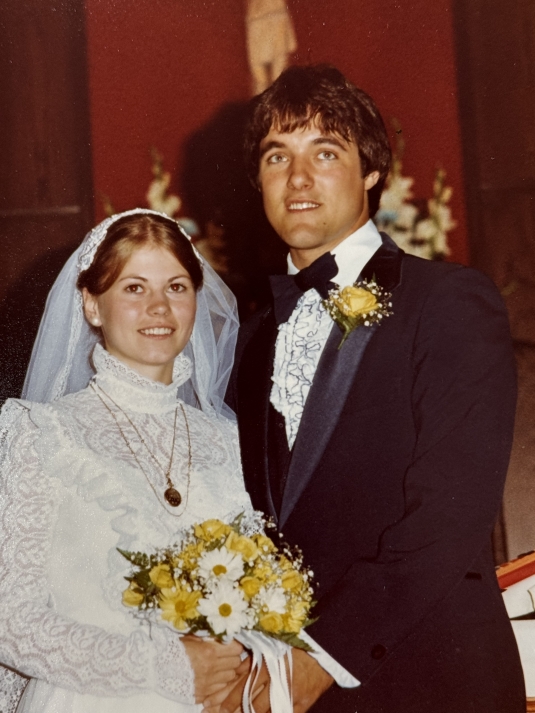
Chuch and Lora Root on their wedding day in 1980. Chuch believed he was leaving the specter of sexual abuse he encountered at age 12 behind, but found its effects reappearing as he went on to become a father and coach.
Chuch Root tells his tough story
Thu, 01/08/2026 - 1:30am
At 67, Waseca area resident Chuch Root can list off many accomplishments. Chief among them are 45 years of marriage with his wife Laura, the three sons and the daughter they raised together, and a whole collection of grandchildren. Prior to retiring, he had a 35-year career as a press mechanic and a long list of personal achievements, including acting as a wrestling coach during his children’s youth.
But along with all those positive elements are after-effects from a very ugly set of occurrences which took place when he was 12 years old. “It just won’t stop,” he says of memories, thoughts, and emotions which come upon him without warning when he encounters a trigger, even as much as 55 years later.
Root describes how, at age 12 in 1970, he joined a local boy scout troop. At the time, the troop owned a sailboat which he had persistently noticed on Clear Lake. “I joined because I wanted to learn how to sail,” he remembers. “I wanted to know how the mechanics of sailing worked, and how the boat could move against the wind.”
One of the troop leaders was Jack Krough, then 20 years old, a Waseca High School graduate who had already begun attending Morningside University in Sioux City, Iowa, and was working toward a degree in theology.
Root describes having been impressed and showing respect for Krough both because he seemed so smart and capable, and because he was in a leadership role. So if anything, he was flattered by an invitation to visit with Krough in his parents’ home.
Root can still name the address, even though the house has not been associated with the Krough family for decades. Even driving on streets in the neighborhood, he mentions, causes him to feel on edge.
Over the summer, Krough repeatedly convinced his young troop member to take part in sexual activities. “I didn’t even know what sexual activity was,” says Root bitterly. “I was raised to respect and trust authority figures and Jack Krough took advantage of my innocence and my trust.”
Root was also a consistent young member of the Catholic Church, having attended Sacred Heart School for a few of his elementary years, and having completed his first confession and first communion. He would go on to be confirmed in the Catholic faith during his eighth-grade year.
At 12, Root observes, he had paid very little attention to intimate relationships, and had no idea homosexuality even existed. He comments that, like most 12-year-olds of the 1970s, he probably would have denied his own parents interacted intimately.
“I was gullible, and I was available,” he observes. “I didn’t really understand the meaning of ‘victim.’”
Krough instructed him to “keep this between us.” Partly because he had been asked by an authority figure and partly because he didn’t really know what “this” was, Root says he told no one. That fall he entered middle school and began to hear locker room talk among other boys which introduced him to the terms and prejudices of the day. Though he asked no questions, he began to piece together what “this” had been. After Krough approached him again the following summer, Root severed contact with him. As his activities with the scouts continued, he found himself watching Krough from something of a distance, paying attention to see whether he was approaching other boys.
As he went on to high school and his eventual graduation in 1976, Root’s silence continued. By this time, he was well acquainted with the era’s homophobia, and kept quiet to avoid falling victim to it.
Krough entered the seminary and was ordained as a priest of the Diocese of Winona in May of 1976, on the same day Root turned 18. Krough sent him an invitation to the celebration; Root threw it away.
Though he was resentful of Krough, he says he believed that, since he had completed training offered by the Catholic Church and been allowed to become a priest, Krough would no longer act in ways not pleasing to God.
He wishes he had been right.
In 1980, Root married the woman of his dreams, Lora Hulburt, and they began to raise a family.
Not constantly, but persistently from ages 12 to 22, he would be in places or circumstances that caused him to recall the abuse. He resented that his innocence had been taken from him, interfering with what should have been his first relationships in high school.
When he and Lora were married, it was by a Catholic officiant in Sacred Heart Church. But Krough’s position as a priest eroded Root’s connection with Catholicism, so that once he and Laura began raising children, the family attended a Lutheran church, the denomination Laura had been brought up in. Though he never officially ended his membership at Sacred Heart, he attended the Lutheran church with his family. “The minister didn’t seem to mind,” he recalls.
After he began coaching youth sports, Root could not help thinking about how easily the young athletes could be influenced by predators in the same way he had been.
“It’s all about the kids,” he explains. “Sports are about helping them learn and grow.”
But while researching the topic of sexual abuse, Root had learned that, statistically, one in every five children is likely to encounter some form of abuse before the age of 16.
He could not avoid doing the math in his head. That meant, of the 300 boys taking part in a Saturday tournament, 60 would become victims.
He says that, even though his attention was meant to be on the competition, he would scan the crowds and watch how adults interacted with children, looking for any sign that someone might be a predator. Rather than straightforward appreciation of athletic skill and growth, tournaments were a time of anxiety for him. “I felt a responsibility to save anyone I could.”
“I got to be 20 years old, 30 years old, 40 years old, and still I never told anyone,” remembers Root. “I was worried about how my family members would feel, how it would affect their relationship with the Catholic Church,” he describes. “Sexual abuse is a topic that makes people uncomfortable because they don’t know how to react or what to say.
“It’s been more than 50 years now, and all this time I’ve barely ever spoken about it.”
In the mid-1990s, a chance conversation with an acquaintance revealed that Krough had been placed at All Saints church in New Richland. Root remembers becoming instantly angry and giving an emphatic warning that Krough should be “kept away” from children.
Determined to confront Krough and give him a good dressing down, Root approached him shortly after a mass. When their eyes met, Root says he is certain Krough recognized and remembered him, but Root found himself frozen and unable to speak. Eventually he left, not having spoken a word.
“It was like I was back to being a 12-year-old,” he speculates. What he did bring himself to do, though, was to contact the Diocese, say that he had been victimized by Krough, and insist that the priest be reassigned elsewhere or he would make what he knew public. Shortly after, Krough had moved on.
Information published online by the Diocese of Winona reveals that, by 1993, the church had sent Krough for evaluation after a photo of a naked minor was found among his possessions. In 1997, proof of abuse that had occurred around 1980 led to him being sent for treatment, then assigned to an all-female congregation at the Sisters of St. Francis of Assisi in Rochester.
Krough left the priesthood in 2002. He died in 2014 at the age of 65.
Root’s inner turmoil became nagging discomfort as he heard news of minors abused by Catholic priests.
He was tortured by the possibility that, if he had spoken up, at least Krough–whose name is one among 18 released by the Diocese through 2016–would not have been in a position to abuse children. That turmoil eventually interfered with his job performance and his behavior toward his co-workers, starting a spiral that led to a diagnosis of post traumatic stress disorder and an earlier-than-planned retirement.
Now, with the open schedule of a retiree for whom “every day is Saturday,” he is still coping with the sense of betrayal and loss which followed in the wake of summer, 1970. He did, eventually, join the class action lawsuit against the Diocese which led to millions of dollars in claims and filing for bankruptcy in 2018. He received a minor monetary settlement, but most importantly, he feels, he added his name to a list that reminds the Diocese of its responsibility.
He says he recently attended a Catholic mass for the first time in more than 35 years; he describes a sense of having returned “home.”
“The people at the church, they’re the ones I got off the bus with at Sacred Heart School when I was in first and second grade,” he says. “They’re part of my history and part of who I am.” He says despite the long hiatus, being back at Sacred Heart had him feeling he was in the company of family and friends, standing back on familiar ground.
But simultaneously, he felt resentment against the larger organization of the Catholic Church, which did not manage to protect him and the many other minors who experienced sexual abuse, and then took decades to acknowledge the crimes committed by some of its priests.
Root says he contacted the Waseca County Pioneer to share his story because he still feels an obligation to protect.
“I wish it weren’t, but abuse is still happening,” he points out.
A “Quick Facts” summary published online by the Minnesota Department of Health uses statistics from 2022 to show “at least 8 percent” of Minnesota’s eighth-graders have experienced sexual violence, and by eleventh grade, at least 16 percent have–one in six.
His experiences–his childish feelings of shame, his parental impulse to protect, his guilt and inner conflict over not having spoken up, his emerging understanding of alienation and loss–all make it clear the after-effects of abuse are lifelong and far-reaching.
Speaking of both religious and civic organizations that work with children, Root claims, “They’ve got to recognize their responsibility.” He clarifies this means steps should be taken to screen adult leaders, and, once abuse has occurred, recognize and support the victims.
“It doesn’t go away,” he says regarding the intertwined consequences the childhood abuse has had for him. “Sometimes people might think I’m overreacting to something that doesn’t seem that important, but they don’t have any way to understand the conflicts that are going on inside.”