
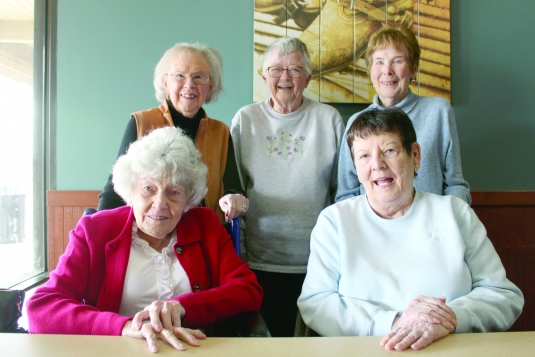
The card game Bridge has provided a decades-long network of support--and hours of good-spirited ribbing--for this group of Waseca ladies. They are (front, from left) MaryAnn Madel, Jacque Storby, (standing, from left) Wilda Smith, Cookie Rausch, and Phoebe Praxl. Pioneer photo by Deb Bently
Card sessions “bridge” changes
Wed, 04/16/2025 - 8:12pm
When Wilda and Keith Smith and their family moved to Waseca 45 years ago, Betty McIntire, who operated the drug store with her husband Homer at the time, pulled aside an out-of-town visitor who had stopped to ask for directions. “There’s something I have to ask you about Wilda,” Betty said with disconcerting urgency.
“Does she play Bridge?”
The name of the card game Bridge, it seems, has a double meaning—while it provides entertainment and challenge, it simultaneously serves as a way to overcome gaps.
Five long-standing Waseca residents have a lot to share on the subject. The five of them, ranging in age from 81 to 94, get together twice a month to spend a few hours playing Bridge while also enjoying each other’s company: MaryAnn Madel, Cookie Rausch, Phoebe Praxl, Jacque Storby, and Wilda.
After hearing Wilda’s story about Betty McIntire, all five of them agree: Betty was “Mrs. Bridge” in Waseca back then, persistently arranging get-togethers which centered around the game.
“Dozens of people played,” remembers Phoebe, now retired from her decades-long work as a teacher at the Waseca High School. “We would get together and play as couples.”
“There used to be several Bridge clubs in town,” points out Jacque. “Now we’re probably the last one left.
“We’re keeping it alive.”,
“So far, so good,” chimes in Cookie.
Among them, the five ladies spent 283 years married and raised 14 children to adulthood. All are now widowed and most live on their own, but they’re still playing Bridge.
Along with Phoebe, both Jacque and Cookie had careers in education, and were also married to teachers. Jacque was part of a class-action lawsuit in which all female faculty members of the (then) University located in Waseca sued the school, and won, because it was easily proven the male members of the staff were receiving higher pay based not on their qualifications, but their gender.
The three teachers also share stories of “convenient” policies. Two relate how they were rejected for teaching positions because of a “policy” that if their husband worked for the district or campus, they could not have jobs there as well. Another was told her teaching license did not meet the criteria for a specific job. Yet, when unexpected vacancies occurred and the positions needed to be filled on short notice, the policies became unimportant and the ladies were hired—at lower salaries than their husbands’.
“That’s how it was back then,” all five Bridge players concur. “The woman’s job was treated with less respect because she wasn’t the ‘head of household,’’ observes Phoebe.
“Those were the olden days,” says Jacque.
“Don’t get us started,” jokes Cookie.
Despite the warning, however, a discussion about ways things have changed continues.
MaryAnn mentions having learned to drive–with adult supervision–at age 11 and receiving her South Dakota drivers’ license at 13.. She explains her father had grown up on a family farm, “and he just hated it, so he got out of there as quickly as he could.”
Yet after starting a family and while living in town, he purchased some acres in the country where he kept cattle. “My father taught me how to drive and got me a license so I could help check on them,” she explains.
Noting that it’s somewhat ironic because her husband LeRoy, widely known as “Storb,” taught drivers’ education, Jacque says she did not learn to drive until after she was 21. “We didn’t have a car that I could drive,” she recalls of her own youth.
Asked about other ways Bridge has played a role in their lives, the ladies return to its social aspects. “I got to know people I would otherwise never have met,” most of them say in their own words.
Phoebe tells how, when she moved to town in 1973, the game opened doors for her. “As soon as they found out I played bridge, I started being invited,” she recalls. As she was raising her children, she remembers the “Bridge Club” would rotate among the players’ homes. She describes how her children very much enjoyed the evenings the party would be at their house. “They thought it was fun to serve the guests,” she says, pointing out, “Of course we always had to have some sort of a treat.”
Cookie remembers her participation in a Bridge group as something of an escape during the time she was a stay-at-home caretaker for her children. “We would bring them along,” she said of herself and the other mothers. “The children would play together in one part of the house, and we’d play cards in another.” She recalls valuing the opportunity to interact with others on an adult level.
Wilda tells the story of a time when she and fellow retiree Toddy Smith were spending part of the winter in Florida. After seeing a newspaper ad which invited all interested Bridge players to an area club, the two made arrangements to take part.
Based on their own Bridge clubs back in Waseca, the two arrived dressed rather casually—“I was in my golf clothes, and Toddy just wore everyday clothes--slacks and a top.” Once at the venue, however, they discovered things were done differently there. “Everyone was very dressed up,” she comments, remembering the women were all wearing nice dresses and one woman even had a colorful bow in her hair; all the men were wearing suits and ties.
She tells how she and Toddy were seated with two men as their opponents, and how the two seemed unimpressed with the Minnesotans. Their sense of being out of place continued as paper and pencil were distributed and everyone began to write something down. After Toddy expressed confusion, the two women were told players were listing the “conventions” they used.
When they showed confusion regarding the request, one of the men “looked at us over his nose and he asked, ‘You don’t play any conventions?’ in this really superior way.”
After a few moments’ thought, the two women realized they did, in fact, follow some specific practices that should be written down. Still, the men’s demeanor left a sour taste in Wilda’s mouth as play began.
“But do you know,” she says, hitting the table, “we upped those stuffed shirts.
“It felt really good when Toddy and I advanced to the next table and left them sitting there.”
She mentions the two of them returned to that Bridge club a number of times, always remembering to dress a bit more nicely than their everyday clothes. “We were never in last place,” she says. “We always ended up placing somewhere in the middle.”
Over time, the five make clear, the number of people with both the skills and the inclination to play Bridge has grown smaller, despite the excitement and challenge the game provides.
They admit the rules of the game are a bit complex, “But with a little effort, anyone can learn them,” says MaryAnn. Still, “Young people just don’t take the time,” observes Jacque.
As for their contemporaries, well, their numbers are diminishing. “We’ve had too many funerals already this year,” says Phoebe.
The five ladies have continued their own Bridge club through it all. Until a couple of years ago, they followed the long-standing practice of rotating their get-togethers among each other’s homes, but stairs and narrow doorways created accessibility problems as time went on.
Now they meet every other Thursday at Pizza Ranch in Waseca, a business owned by MaryAnn’s son, Pete Madel Jr. The single level, open floor plan allows easy accessibility for all; the large, smooth-topped tables are good for dealing out hands and sweeping in tricks. The staff is friendly and patient, allowing the card players to continue their games as the buffet hours end and clean-up time begins.
Despite any rules or conventions limiting “table talk,” the group behaves in perhaps the opposite way from what most might anticipate.
“Are you gloating?” asks one playfully sharp voice.
“Yes, I suppose I am,” comes a cheerful reply.
“Well…stop it!” says the first speaker.
“It wasn’t luck,” someone proclaims. “We played that brilliantly.”
The words “shut up” are spoken occasionally, and players on opposing teams sometimes allow others to see their cards.
All admit their social time together is vastly more important to them than the score.
“We just have fun,” says MaryAnn. “It feels good to get together. It feels good to laugh and joke.”
“Who wins, who loses, it’s not worth any sort of argument,” expounds Cookie. “It’s certainly not something we would want to lose any friends over.”