
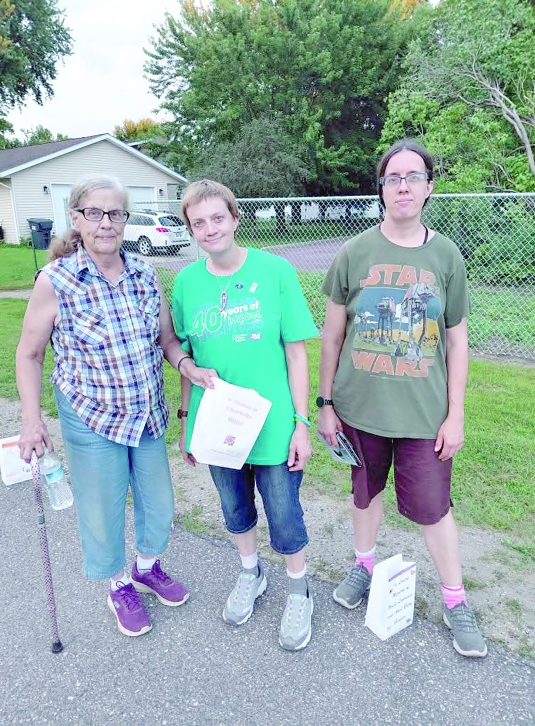
SURVIVOR - Waseca area resident Kim Maas was diagnosed with ovarian cancer just over one year ago. She has now been cancer free since April. Maas (center) with her mother Sue and sister Rebecca during a recent Relay for Life event.
Cancer Awareness
Survivor Kim Maas tells of her battle with ovarian cancer
Survivor Kim Maas tells of her battle with ovarian cancer
Thu, 10/02/2025 - 2:30am
After two surgeries and chemotherapy, Waseca area resident Kim Maas has been cancer free since April. Because there have been times over her one-year battle with ovarian cancer when she questioned how many days she had left on earth, she observes, “I feel fortunate to be here; every day is a blessing.”
But along with that, she says, when it comes to “the big C,” “I don’t think I can ever feel confident again. It’s dangerous to be confident.”
Kim, her mother Sue, and her sister Rebecca recently took part in the Murray County Relay for Life in August at the Murray County Fairgrounds. On September 20, she and Rebecca went to the Steele County/Waseca Relay. The combination of being with family and helping support the
American Cancer Society seems representative of Kim’s recent journey.
“When I first learned I had cancer, I thought about my family,” she remembers. “I didn’t want them to go through the pain of losing someone they love.” Along with that, “I wanted to know everything I could about cancer that could help me survive.”
Kim recently contacted the Waseca County Pioneer offering to share her experiences in honor of September being recognized as gynecologic and ovarian cancer awareness month. Whenever it’s told, her biggest hope is that her story can be of help to others.
“You know your own body,” she says regarding any warning signs or symptoms. “If something about your health or your healthcare doesn’t seem right, you have to advocate for yourself.”
Referring to ovarian cancer as “a very silent killer,” Kim acknowledges many of the symptoms can easily be attributed to other causes, or dismissed as unimportant. She offers the examples of increasing frequency of urination, fatigue, unexplained weight loss, reduced appetite and bloating.
In her case, she says, it was possible to overlook three telling incidents because they came weeks apart and did not seem related to each other. It began with a change in how she experienced her monthly periods. In January of 2024, she describes being in so much pain she could barely move–a definite change from before. But when the pain was much less by her February period, she dismissed it as an anomoly or a change due to aging. Another unrecognized warning sign occurred just after she had donated blood; despite having donated many times before without experiencing problems, she became so lightheaded she needed assistance to get to a nearby chair with a fan.
In March, she experienced what she took to be a very severe cold. When she visited a doctor for lingering congestion and trouble breathing, she requested a chest x-ray, but was instead prescribed steroids.
“By August [2024] I could barely breathe,” she remembers. Although she is an avid walker, things reached a point where “I could barely get to the end of my driveway.” After a chest x-ray revealed bilateral blood clots in her lungs, Kim was prescribed blood thinners and underwent further testing which revealed a tumor on her right ovary. When it was surgically removed in September, the tumor was discovered to be about 7 inches in diameter. It was also learned it had “burst” only a few days before, potentially releasing infectious elements into the rest of her system.
In the case of ovarian cancer, Kim warns, the majority of patients end up having both ovaries and their uterus removed, rendering them infertile. In her mid-thirties, she says she had never intended to have children, but she feels tremendous sympathy for others who not only experience the terrors of fighting cancer, but also lose the chance of someday giving birth to children.
The next step was 18 weeks of chemotherapy. The treatments left her feeling nauseous, fatigued, isolated, and emotionally low.
“Depression is a very real side effect of cancer,” she says. “How could it not be?”
She describes a repeated inner dialogue of fear and doubt–not only feeling physically weak because of chemotherapy, but wondering whether it would work or, after the surgery and physical suffering, she was going to die anyway.
“So there you are, worried, exhausted, and unable to sleep.”
She says she knows there is something of a stigma about seeking treatment for mental illness, but people should ignore the stigma and recognize the value of quieting that dark inner uncertainty. For her, she says, a combination of medicines and therapy have been very important. She has also found tremendous value in renewing her connection to religion and faith.
When it comes to undergoing the many procedures and treatments associated with fighting cancer, Kim suggests seeking the company and advice of fellow cancer survivors. Having already walked the road, they not only offer emotional support, they have knowledge and experience when it comes to medications, services, support organizations, and medical practices. They can share information, advice, and personal perspectives to help ease anxiety about approaching treatments.
Kim expresses gratitude for the support and assistance of the late Bea O’Brien of Waseca, and of Linda Tobias, her own supervisor at the Minnesota River Agency on Aging in Mankato. With more than 40 years as a cancer survivor, Kim says, Tobias has been in a place to provide tremendous personal and social support.
In Kim’s case, a scan after she completed six chemotherapy treatments across 18 weeks showed something suspicious near her spleen. Surgery in April of this year led to the removal of an 11-centimeter tumor which had attached to her diaphragm, the muscle used to cycle air in and out of the lungs. A small piece of her diaphragm had to be removed along with the tumor.
“I feel really fortunate I was eligible for a second surgery,” says Kim.
Though it may seem obvious, Kim suggests people have genuine, deep conversations with medical personnel, always speaking up when something doesn’t seem quite right and also ensuring providers truly understand any concerns and expectations. Cancer patients should seek out professionals who have knowledge and experience regarding their particular situation.
In that regard, Kim says she feels fortunate in having been treated by a team of doctors and surgeons specializing in cancer of the female reproductive system who seemed very up-to-date on recent research and techniques.
At this time, she has a follow-up meeting with a gynecological oncologist every three months.
Despite having been cancer free for five months, Kim says on a psychological level, she questions whether she can ever be truly “free” of the disease. “I worry every time I go in for a scan,” she says, “because I can’t help thinking I’ll learn it’s come back.”
In the meantime, she hopes her advice will be valuable to others.
She suggests there is real value in genetic testing to see whether individuals are prone to any certain type of cancer.
She warns that ovarian cancer is not “only for older people,” mentioning she has been in support groups and conversations with numerous women in their twenties and thirties who have been diagnosed.
She suggests people become acquainted with the terms of their insurance, since different companies and plans have widely different coverage policies, and surprises can be unsettling.
And perhaps most importantly, “don’t put off seeing a doctor when you have unexplained problems.”