
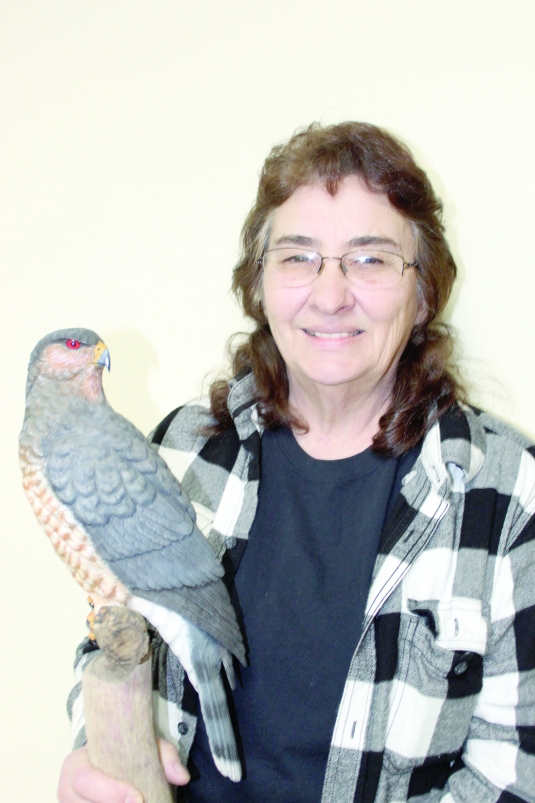
Local artist Robin Warburton has two especially large projects underway. Especially known for her lifelike sculptures of birds, she estimates she has completed close to 400 so far. Photo by Deb Bently
Artist Robin Warburton takes on two special projects
Wed, 04/16/2025 - 8:14pm
Janesville area artist Robin Warburton has shown her sculptures in the Waseca Art Center and consistently has her work on display in galleries around Minnesota and even in Branson, Missouri. She estimates she has created well over 300 sculptures of birds in sizes ranging from hummingbirds to large raptors. Gallery owners typically price her work somewhere between a few hundred dollars for smaller pieces to even as high as $10,000 for larger ones.
Two pieces she is currently working on, she suggests, might be accurately priced at 10 times that much, if they were ever to be offered for sale.
The first, a full-sized bald eagle with wings outstretched and talons open, is due to be unveiled in November during a display titled “Minnesota Nature Alive in Wood” at the Waseca Art Center.
The second piece, still in the prototype phase, is an accurate, larger-than-life-size reproduction of “Alice,” an adult great horned owl central to the education and fund-raising work of the International Owl Center in Houston, Minn.
Creating a life-sized sculpture which depicts the commanding presence and detailed elegance of an eagle is a project which Warburton says has been calling to her since her career as a sculptor began about 10 years ago. As her skills and experience in representing wildlife have grown, the urge to craft the eagle has continued–so much so, in fact, that she applied to the Minnesota State Arts Board and was delighted when she learned she was among the 362 “artists or culture bearers” who had been awarded funds this year.
“Now I can finally make the eagle,” she says simply. She estimates the body, wings, legs and feet of the bird, being constructed in pieces, are about 20 percent finished at this point, and have already required hundreds of hours of work–with the time-consuming task of adding hand-sculpted and painted details still ahead of her.
Warburton makes many of her sculptures, and most importantly the larger ones, out of carefully selected pieces of tupelo wood. The tree is quite common across the southern part of the U.S., and is known for thriving in swamps, where the bottom few feet are frequently covered in water. She explains that, while the top part of the tree produces a strong, attractive wood suitable for woodworking tasks such as making furniture, the submersed part grows to be particularly lightweight and has many characteristics prized by sculptors.
The special wood can be quite expensive: a single block of it about 12 inches wide and tall and 48 inches long cost her around $1000; some pieces acquired for making the eagle were larger, with each wing being close to 36 inches long. A skilled woodworker, Warburton explains she spliced some pieces together in order to have blocks large enough to begin.
Warburton, 66, has been married to her husband Marvin for 45 years. The two have spent their life together on a farm southeast of Janesville where they once kept cattle, sheep and pigs and now continue to raise crops. They raised their daughter Ann and son Mike: Mike, his wife Sarah, and their 2-year-old son William now live nearby on the same property.
Right out of high school, Robin attended South Central Technical College in Mankato and earned a degree in architectural drafting. She held jobs with various area construction companies in addition to the work performed on the farm.
“There was no time back then,” she says of her creative side, although she mentions small projects she worked on occasionally, including some cartoon-like characters she carved based on a “how-to” book once acquired on vacation.
She and Marvin have consistently sought out opportunities to be in nature. Both are avid anglers, with a number of mounted fish caught by each of them on display in their home. Mingled with the real fish are carved ones, some mounted as though swimming through beds of lily pads.
“We love to appreciate natural settings,” Robin says of the many camping trips that are part of family history, including from a time when their children were small.
“The more you look at natural things,” she observes, “the more you appreciate them.”
Robin’s workshop includes tools capable of shaping wood in increments from meters down to millimeters. A band saw stands only a few feet away from grinding tools similar in size to those used by dentists.
She picks up a piece of wood she has used for practice and shows a burned-in pattern of layered feathers or scales she often uses to add texture underneath the painted layers of decoration on finished pieces. Though not located among the tools, another vital resource is a collection of books which show photographs and provide specific information about many types of birds. Robin says she uses the books, along with online photographs and statistics, to ensure her finished products look as much like the real thing as humanly possible.
“I work on it until I get it right,” she mentions. “If I look at it and I’m not satisfied, I’ll take it apart and fix it.”
Mixed richly among the finished and partially finished pieces in and near her workshop are owls; one easily 24 inches tall, others only expressive faces peering out from knotholes of wood.
Robin has sculpted numerous sizes and poses of owls partly because she admires the conservation and protection work being done by Karla Bloem of the not-for-profit International Owl Center located in Houston. Robin’s sculptures are consistently for sale in the center’s gift shop, in some cases being sold even as they are being placed out for display.
Clearly impressed with Robin’s workmanship, Bloem is writing a grant to have her produce a larger-than-life-size, sculpted portrait of one of the center’s best-known occupants: Alice, an adult great horned owl. Alice must be kept in the sheltered environment of the center because she has a damaged wing which droops slightly below her body. The loss of symmetry causes a particular feather to be distinctly visible, making Alice easy to identify.
The center is currently located in a former retail building, but is well on its way to constructing and occupying a location built to satisfy its particular needs.
Bloem has asked Robin to create the sculpture in a way that makes it seem as if Alice is leaning out above people as they enter the new location, perhaps as though admonishing them to behave respectfully during their visit.
“I want people to see that bird and really feel as if they’re being watched,” says Robin. “I think it will send a message about how each animal is an individual with its own characteristics.”
In preparation for the “Alice” sculpture, Robin has created a detailed prototype only five inches long. True to the idea of being a three-dimensional portrait, the sculpture’s left wing droops and a distinctive feather stands out.
Robin reveals that when she went to the center to show Bloem her prototype pieces, she took the miniature sculpture and a full-sized reproduction of the noticeable feather mounted on its own small stand. As Robin was showing the two pieces to Bloem, a visitor begged to purchase the feather–and did so within a few minutes.
Also underway in Robin’s workshop is another owl peering out from a knothole, as if it were inside a full-sized tree. Robin is working to imitate another piece she had made previously because when she took the first one to the owl center, two visitors adamantly wanted to purchase it. The person who spoke first received the original; the second buyer will receive his shortly, when it’s finished.
Nearby in a partly finished state is a crow; Robin explains someone contacted her to commission it after seeing some of her other work. Lying on its side on a counter is a large-mouth bass 20 inches long, its open jaws seeming large enough to swallow a person’s hand. The right shape and size, the fish is still mostly the color of unfinished tupelo wood, although much of its body is tattooed with wood-burned lines of scales and gills.
Indicating the many projects underway, Robin shrugs, smiles, and comments that she likes to work on things in phases rather than performing the same, often repetitive tasks for long periods of time.
Despite the prices her sculptures bring, she refers to her work as “a really nice hobby.” Given the number of hours each project takes–she estimates “Alice” will require about 3,000 hours from start to finish–”I would be surprised if it works out to $10 an hour.” She is not bothered by this, however, since “making money was never the point.”
When her work is on display, she says, “I love standing back and watching what people do.” Some of her deepest moments of gratification come, she mentions, when viewers want to touch the sculptures because they want to feel the “feathers” before they’ll believe they’re not real. She describes a time when one viewer looked at her sculpture of a barred owl and announced, “I want to hug him!”
“That’s a really good feeling,” she recalls. “It makes me feel like I’m headed in the right direction.”