
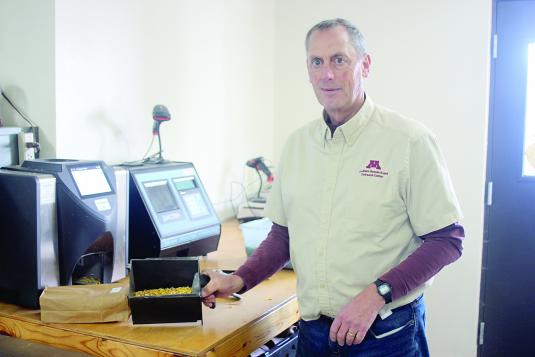
EXAMPLE - Tom Hoverstad shows how the U of M Southern Research and Outreach Center analyzes corn samples for moisture content and other important data.
40 years for Tom
Sat, 12/31/2022 - 11:11pm
Very few people can say they’ve worked at the same place for 40 years.
University of Minnesota Southern Research and Outreach Center agronomist Tom Hoverstad can.
Hoverstad recently received a plaque recognizing his 40 years of service to the Southern Research and Outreach Center at the organization’s annual staff appreciation luncheon Thursday, November 17. He is currently the oldest and longest-serving staff member at the SROC.
“I enjoy it,” Hoverstad says. “Every year is a new learning opportunity. Every year in my 40 years, I see something I’ve never seen before.”
Hoverstad’s journey in agronomy started on his family’s farm in Goodhue County near the small town of Dennison. After graduating from Kenyon High School in 1978, he attended the University of Minnesota where he studied agriculture.
“I was mostly interested in a career where I could be outdoors,” Hoverstad claims. “I’m not an office guy.”
Agronomy, the science of soil management and crop production, was the perfect fit for him. When he was in his senior year of college, an opportunity opened up at the Southern Research and Outreach Center in Waseca. He was doing some research to finish his agronomy degree when he was made an offer to join as a researcher in agronomy plots.
“I graduated on a Thursday and started here on a Monday,” he remembers fondly.
Despite agronomy looking like a good fit for Hoverstad, he was unsure if that part of agriculture was his calling until he started. “When you go to school, you learn about the field,” he explains. “But once you start doing all the things you learn and get acquainted with what the day-to-day activities are, that’s when you decide, ‘This is for me.’”
Hoverstad’s typical day depends on the season. During mid-winter, when things are the most quiet, the SROC gets requests from the University of Minnesota faculty to use SROC facilities for research. “The first thing we do is make sure we have what we need, such as fertilizer and labor. Then we ask ourselves, ‘Can we get it done?’”
Naturally, winter is when Hoverstad and the SROC staff spend the most time preparing everything for the growing and harvesting seasons. “We get a lot of interaction with university faculty that want to have research here so that in the spring, everything’s ready to go,” he elaborates.
With the spring comes the planting season, which gets busy. “You have to get things done when the weather cooperates,” Hoverstad says. “It’s a lengthened season because some of our trials are started early. Others need to wait for the right conditions to plant.”
The SROC growing season lasts about two months. When they aren’t doing planting, the staff prepares areas for research.
In the summer, the SROC does two things all the time: applies treatment applications to the crops or takes measurements for research purposes. “Weed trials need herbicide, for example,” Hoverstad explains.
Fall is more outdoor work collecting all of the information and finding out how all the crops responded to the applied treatments and techniques. Near the end of fall and early winter, the SROC distributes its information while figuring out what to do in the next year.
In addition to helping with agronomy research, Hoverstad provides crop reports and weather updates to local media outlets. “Every month, KAAL calls me and we do a radio piece about what’s going on,” Hoverstad elaborates. “We also create crop and weather updates that a lot of media sources put out. Occasionally when there’s a disaster such as drought or floods, we’ll send a report on that, too.”
Among the memories he’s acquired are close calls when he and other researchers are taking samples from the field before thunderstorms roll in. Fond memories are when he gets to talk to the local farmers.
“When a farmer tells me what I showed them over the years helped them, those are the things that make you feel good about what you’ve done,” he says.
What’s helped Hoverstad adapt with the times in the agriculture industry over his four-decade career? He says the personal computer helped him out. After the collecting process finished, he reminisced when the SROC had to send things through a phone line on campus to a mainframe computer. “We then bought the first PC that IBM came out with,” Hoverstad says. “I really dove into that and appreciated that we could do things on that machine.
“Things have changed so much since then, we now have handheld computers,” he continues. “We used to have someone in the plot combine in the dust, cold and wind weighing samples and writing down the data. Now it’s all automated.”
The technological advancements make Hoverstad believe that there’s something for everyone in the agriculture industry, whether out in the field or in an office crunching numbers. “It’s always changing and advancing,” he says. “If you’re interested in electronics, it’s advancing there. Farmers will always need help with financing, too. There are plenty of opportunities in this industry and they will always be here.”
As the years go by, many people move on to other places. But not Hoverstad. Why did he stay in Waseca? “It’s a good place to raise a family,” he replies. “We really enjoy the community here. That’s been a big factor for us staying.”
Hoverstad adds that the SROC facility is important to the University of Minnesota. “Certainly the university’s biggest resource is the property we’re on. It’s the people that take care of it that are really the biggest asset they have. You have to take care of the land here, and it’s not the easiest land to farm. But if you’re willing to put in the effort, you can be productive here. And that’s what we do.”