
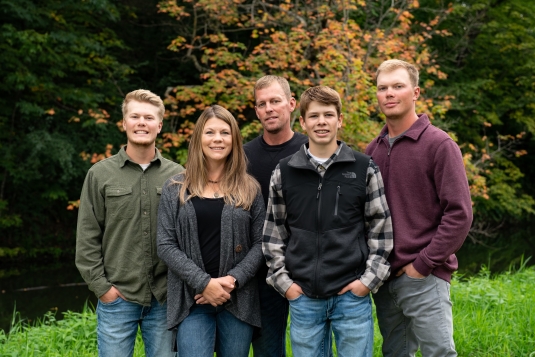
The Staloch family, from left, Nick, Ronda, Chad, Seth, and Cole.
‘Mind over matter’
Staloch’s fight with breast cancer
Staloch’s fight with breast cancer
Fri, 12/15/2023 - 7:25pm
“I kept getting bad news,” remembers Ronda Staloch, 49, who was diagnosed with breast cancer in July of 2016.
The Hartland resident and mother of three discovered a lump during a self examination in July and, since it was coming toward time for her annual mammogram, checked with her doctor. Strangely, though the lump was obviously present, the 27 different views taken by the radiography department in August did not show it; it was later learned its composition was a type not susceptible to detection on mammograms. An ultrasound led to the news that a biopsy was needed.
“It seemed like every time I left the doctor’s office, there was something I had to decide.”
Staloch tells of learning that what first seemed like a two-centimeter lump was actually three lumps with a combined diameter of about 9 centimeters. She describes learning that rather than a “lumpectomy” she would likely need a mastectomy. And then, when cancer was found in her lymph nodes, that chemotherapy would be necessary. The news that her genetics include a harmful mutation led to the suggestions she should have a double mastectomy.
With the cancer in her lymph nodes, doctors informed her the most thorough course would be to receive one 8-week round of chemotherapy followed by a 12-week treatment using a different “cocktail.” After that, surgery for the double mastectomy, and finally five weeks of near-daily radiation treatment for “insurance.”
Summarized so quickly, she consents, it sounds nearly unbearable. Encountered piece by piece over most of two years, she wants everyone to know, it was a case of “mind over matter.”
For her, she says, the most important factor was her faith. “The more I trusted in God, the easier things got,” she recalls. “Worrying gets you nowhere. When there’s nothing you can do to change the situation, worrying does more harm than good. If I tried to handle things on my own terms, it didn’t go very well, but if I handed it over to God, it was better.
“That’s how it is for me to this day.”
For anyone intimidated by the idea of undergoing cancer treatment, Staloch also highlights the many forms of support which tend to arise.
“Friends and family, of course,” she says. “I had a lot of people praying for me. They also offered many different kinds of help.” Staloch mentions meals delivered to the family home two or three times a week, rides offered and given to various treatments and appointments. Words of compassion and quiet acts of kindness. She tells of her brother and a friend who bought her a wig so she could feel “more normal” after she lost her hair.
“My work family was very compassionate, too,” she recalls.
Staloch works with accounts receivable and payable at the Hy-Yield location in Hartland. She remembers co-workers stepping in to take care of some tasks, while she was also given flexibility to finish others outside of typical working hours. Thanks to that support, she was able to maintain her job throughout the ordeal.
An invaluable resource for anyone undergoing cancer treatment, Staloch says, is reaching out to cancer survivors, if any “reaching” is even necessary. She remembers others getting in touch with her to offer assistance and share their experiences. One person even suggested she could call or text any time–including “the middle of the night.”
“It’s amazing how many people want to help,” says Staloch.
Yet another source of support are fellow patients also undergoing treatment. For Staloch, this included New Richland area resident Jean Billing and a patient from Iowa who was also being treated at the Albert Lea facility. “We would pull our chairs together, settle down with our blankets and pillows, and just talk,” she remembers about their shared chemotherapy treatments.
Staloch remembers being advised by a friend in the medical field that she should keep a journal. She recommends doing so for anyone undergoing complicated treatments. She not only kept notes regarding medications, treatments and recommendations, but also personal thoughts and reactions.
“When you write things down,” she says, “you can go back over it later. It helps to take the emotions out of things and let you think more clearly.” She also suggests following medical advice, including taking medications on time, eating a healthy diet, and generally doing things to take care of oneself.
Taking things one step at a time is also vital. “You can just sort of plot things out and chip away at the days,” she recalls.
“Every case of cancer is a little bit different,” says Staloch. “And everyone is going to react to it differently. But it’s important to know you can get through it. You won’t be going through it alone–people will help and support you. God will be there for you. And all of us are stronger than we realize.”