
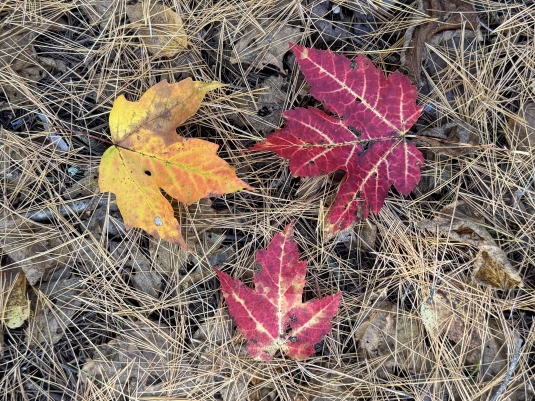
CAPTIVATING CREATIONS - Deb took these pictures of autumn leaves when their striking colors made her feel like their image should be preserved. In this column, she talks about how the beauty of autumn leaves is not the only way they are captivating. Pioneer photos by Deb Bently
More than meets the eye in autumn
Thu, 11/12/2026 - 12:00am
I know I’ve described moments before when I saw something and just had to stop and take its picture. Most recently it was a red tree along Highway 30. A maple, it was still holding on to about half its leaves while the other half had fallen and, apparently sheltered from wind, formed a large red carpet beneath the spreading branches.
Even though it was a cloudy day, the tree and its carpeting seemed to glow, almost as if someone had highlighted it and drawn an arrow with the words “look here.” Or maybe “photograph this.”
When I first spotted it, I was on my way to an interview and didn’t have time to stop, so I left myself a note to be sure and return to it after my conversation. I am not posting the picture I took that day with this column, but have asked that it be posted on the paper’s Facebook page, where you will be able to see it in color, if you are so inclined.
Remembering a column I wrote a few months ago about how tree branches droop when their leaves become heavy with water, I decided to find out a bit more about leaves in general.
According to one online source, a good-sized maple tree produces around 200,000 leaves which together weigh more than 500 pounds.
The components which create the fall colors we enjoy are always in the leaf, which is perhaps why the budding trees on springtime hillsides have a reddish tint to them. As the warming season brings more and more hours of sunlight, the tree pulls nitrogen out of the ground and out of storage in its trunk and sends it into the leaves, where an internal factory creates chlorophyll, the amazing substance that takes in sunlight and carbon dioxide, emits oxygen as a waste product, and produces sugars which are fed back to the trunk and roots of the tree. Chlorophyll is green, and so the yellows and reds of the leaves no longer show under its powerful influence.
The summer solstice arrives on June 21, and by a few minutes at a time, the days become shorter. Online sources say the tree recognizes this, and begins preparing for winter.
Some of the energy that’s been stored over the past brightly-lit months is now invested in forming the buds for next spring’s awakening. The tiny buds are protected by a waterproof coating: If you’ve noticed the ground under a tree peppered in spring by a pale green substance, that is probably the coatings being shed as the infant leaves expand.
I found it fascinating to read about this. The solidity of the tree’s trunk has always left me with the idea it stays the same, changing only in that it adds a ring of growth each year. The summaries I found made it clear I’ve been looking at it all wrong. The roots and trunk are the executives of the tree, making investments when the sunlight economy is strong and cutting their losses as it weakens.
The leaves require “investment” in that the materials to make them and the water to keep them functioning must be pumped up through the woody parts of the tree. The vast surface area that comes with 200,000 leaves is a liability because so much water evaporates off it, forcing the tree to water its “crop” almost constantly. The sugars the leaves produce are the “interest” the tree receives.
According to my online sources, when the tree is no longer satisfied with its return on investment, it cuts off the leaves’ water supply. No longer able to operate its internal power plant, the leaf stops producing chlorophyll, and the pigments which have been hidden all summer become visible. We humans get a one- or two-week display of color, then the leaves die and fall to the ground.
There, as they decompose, their nutrients seep back into the soil, becoming nourishment for growth in some future year.
The fascinating science behind it all only adds to my appreciation of autumn’s beauty. Isn’t creation an amazing place?
